Machine Learning Model To Detect Ddos Attack In Multi Uav Networks
Objective
The primary objective of this project is to develop a robust and accurate machine learning-based system for detecting Distributed Denial of Service (DDoS) attacks in multi-UAV (Unmanned Aerial Vehicle) network environments. This research addresses these challenges by proposing an ensemble approach that leverages the strengths of Decision Trees, Random Forests, and Logistic Regression classifiers.
Abstract
The proliferation of Unmanned Aerial Vehicles (UAVs) in networked environments has introduced new security challenges, notably Distributed Denial of Service (DDoS) attacks. Existing machine learning models aimed at detecting such attacks often overlook the issue of misdiagnosis in classifying covert channels. Additionally, studies evaluating accident severity lack consideration for data heterogeneity and scale. To address these gaps, this research proposes an ensemble approach using decision trees, random forests, and logistic regression classifiers. By combining these models, the proposed system aims to enhance the accuracy and robustness of DDoS attack detection in multi-UAV networks. Through comprehensive classifier testing, the efficacy of the ensemble method in handling misclassification and accommodating diverse data characteristics is evaluated, contributing to more reliable security measures in UAV-based network environments.
NOTE: Without the concern of our team, please don't submit to the college. This Abstract varies based on student requirements.
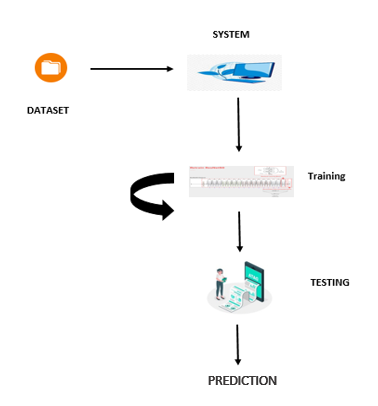
Block Diagram
Specifications
H/W Configuration:
Operating system : Windows 7 or 7+
RAM : 8 GB
Hard disc or SSD : More than 500 GB
Processor : Intel 3rd generation or high or Ryzen with 8 GB Ram
S/W Configuration:
Software’s : Python 3.6 or high version
IDE : PyCharm.
Framework : Flask, pandas, numpy and Scikit-Learn

Demo Video


Request for Video
 Paper Publishing
Request Call Back
Would you like to receive a free callback now?
Choose the best time for callback:
Leave your message and we will contact you as soon as possible

6-2-85/B, Old Maternity Hospital Road, Thyagaraja Nagar, Tirupati, Andhra Pradesh – 517501
+91 9030333433
+91 9393939065
0877-2261612

Disclaimer - Takeoff Edu Group Projects are not associated or affiliated with IEEE in any way. The IEEE Projects mentioned here are mentioned in the context of student projects, whose ideas are derived from IEEE publications, not projects of or by IEEE.

