Machine Learning Framework for Early Detection of Chronic Kidney Disease Stages Using Optimized Estimated Glomerular Filtration Rate
Objective
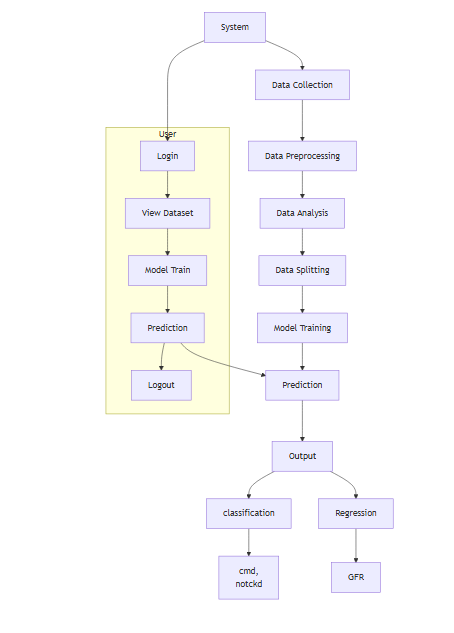
The primary objective of this project is to develop a machine learning framework for the early detection and accurate staging of Chronic Kidney Disease (CKD) using optimized Estimated Glomerular Filtration Rate (eGFR) values. By integrating regression models like Random Forest Regression and Ridge Regression, the system aims to provide precise eGFR estimations. These estimations are then used as input for advanced classification models, such as Stacking Classifier and Voting Classifier, to predict CKD stages. The project also emphasizes model interpretability by incorporating Shapley Additive Explanations (SHAP) for providing insights into feature importance, ultimately enhancing clinical decision-making in the management of CKD. The framework strives to offer a scalable, interpretable, and highly accurate solution to assist healthcare professionals in early CKD diagnosis and effective treatment management.
Abstract
Chronic Kidney Disease (CKD) is a prevalent condition that requires precise diagnosis and staging for effective clinical management. Traditional CKD diagnosis relies on the estimated Glomerular Filtration Rate (eGFR), which is derived from biomarkers such as serum creatinine (SCr) and cystatin C (SCysC). However, the accuracy of eGFR estimation is often limited when applied to diverse patient populations. This proposed study introduces a machine learning (ML)-based framework that integrates regression models for eGFR estimation and advanced classification techniques for accurate CKD staging. The system utilizes Random Forest Regression and Ridge Regression to estimate eGFR, with the latter achieving an impressive accuracy of 0.994. The optimized eGFR values are then used to predict CKD stages via Stacking Classifier and Voting Classifier, with the Stacking Classifier achieving a perfect classification accuracy of 1.0. To ensure model interpretability and support clinical decision-making, Shapley Additive Explanations (SHAP) are used to provide feature importance insights. This ML-based framework offers a scalable, interpretable, and highly accurate solution for the detection and management of CKD, with future work aimed at validating the model with diverse datasets and incorporating additional clinical parameters to further enhance prediction accuracy.
Keywords: Chronic Kidney Disease (CKD), Estimated Glomerular Filtration Rate (eGFR), Machine Learning (ML), Random Forest Regression, Ridge Regression, Stacking Classifier, Voting Classifier, Shapley Additive Explanations (SHAP), Feature Importance, Classification, Detection, Clinical Management.
NOTE: Without the concern of our team, please don't submit to the college. This Abstract varies based on student requirements.
Block Diagram
Specifications
SOFTWARE REQUIREMENS
Operating System : Windows 7/8/10
Server side Script : HTML, CSS, Bootstrap & JS
Programming Language : Python
Libraries : Flask,Torch, Keras, Pandas,Json, Mysql, Sklearn,Numpy , Seaborn
IDE/Workbench : VSCode
Server Deployment : Xampp Server
Database : SQLite
HARDWARE REQUIREMENTS
Processor - I3/Intel Processor
RAM - 8GB (min)
Hard Disk - 128 GB
Key Board - Standard Windows Keyboard
Mouse - Two or Three Button Mouse
Monitor - Any


 Paper Publishing

Request Call Back
Would you like to receive a free callback now?
Choose the best time for callback:
Leave your message and we will contact you as soon as possible

6-2-85/B, Old Maternity Hospital Road, Thyagaraja Nagar, Tirupati, Andhra Pradesh – 517501
+91 9030333433
+91 9393939065
0877-2261612

Disclaimer - Takeoff Edu Group Projects are not associated or affiliated with IEEE in any way. The IEEE Projects mentioned here are mentioned in the context of student projects, whose ideas are derived from IEEE publications, not projects of or by IEEE.

