Machine-Learning Classification of Reactive Power Capability Compliance in Wind Power Plants
Objective
The primary objective of this project is to develop a data-driven reactive power capability compliance classification system for wind power plants using advanced machine learning approaches. By utilizing Autoencoder + Classifier, Random Forest with XGBoost, and Recursive Residual Refinement (R3), the system aims to accurately classify reactive power capability compliance conditions at the Point of Common Coupling (PCC). The project focuses on improving classification accuracy by analyzing important operating features and learning reactive power behavior patterns from historical wind power plant operational data. Additionally, the system aims to enhance model performance by reducing classification errors and ensuring prediction consistency under varying voltage levels, active power conditions, and network constraints. The integration of these classification models helps in capturing complex reactive power behavior and improving compliance prediction reliability. The objective also includes building a scalable system capable of handling wind power plant operational datasets efficiently. Ultimately, the project supports effective reactive power management and voltage security by providing accurate PCC compliance classification.
Abstract
Many methods have been proposed for assessing reactive power capability compliance in wind power plants using optimization techniques, power-flow analysis, and machine learning-based classification approaches that are highly dependent on available operating conditions, network constraints, and PCC monitoring data. However, achieving accurate and stable compliance classification remains a major challenge due to voltage-dependent reactive power behavior, nonlinear operating characteristics, converter limitations, changing grid conditions, and varying reactive support requirements. In this work, we present a data-driven compliance classification methodology that utilizes Autoencoder + Classifier, Random Forest with XGBoost, and Recursive Residual Refinement (R3) to effectively analyze and learn reactive power capability patterns from historical operating and PCC compliance data, improving classification accuracy and decision consistency. The proposed system performs high-precision compliance screening for wind power plant operating scenarios. By utilizing significant voltage, active power, reactive power, and device-related features, the model provides reliable and efficient compliance prediction for real-time PCC capability assessment and supports better understanding of reactive power behavior under different operating conditions. Additionally, the system focuses on enhancing model performance, reducing unnecessary feature complexity, minimizing classification errors near compliance boundaries, and improving generalization capability on unseen operating conditions. The proposed framework can efficiently handle wind power plant operational datasets, ensuring scalability and stable classification performance, ultimately supporting intelligent reactive power management and improving voltage security and grid-code compliance in modern power systems.
Keywords: Reactive Power Capability Compliance, Wind Power Plants, Point of Common Coupling (PCC), Autoencoder Classifier, Random Forest, XGBoost, Recursive Residual Refinement (R3), Compliance Classification, Reactive Power Management, Voltage Security, Grid-Code Compliance, Power-Flow Analysis, Wind Energy Systems, Machine Learning, Data Analysis.
NOTE: Without the concern of our team, please don't submit to the college. This Abstract varies based on student requirements.
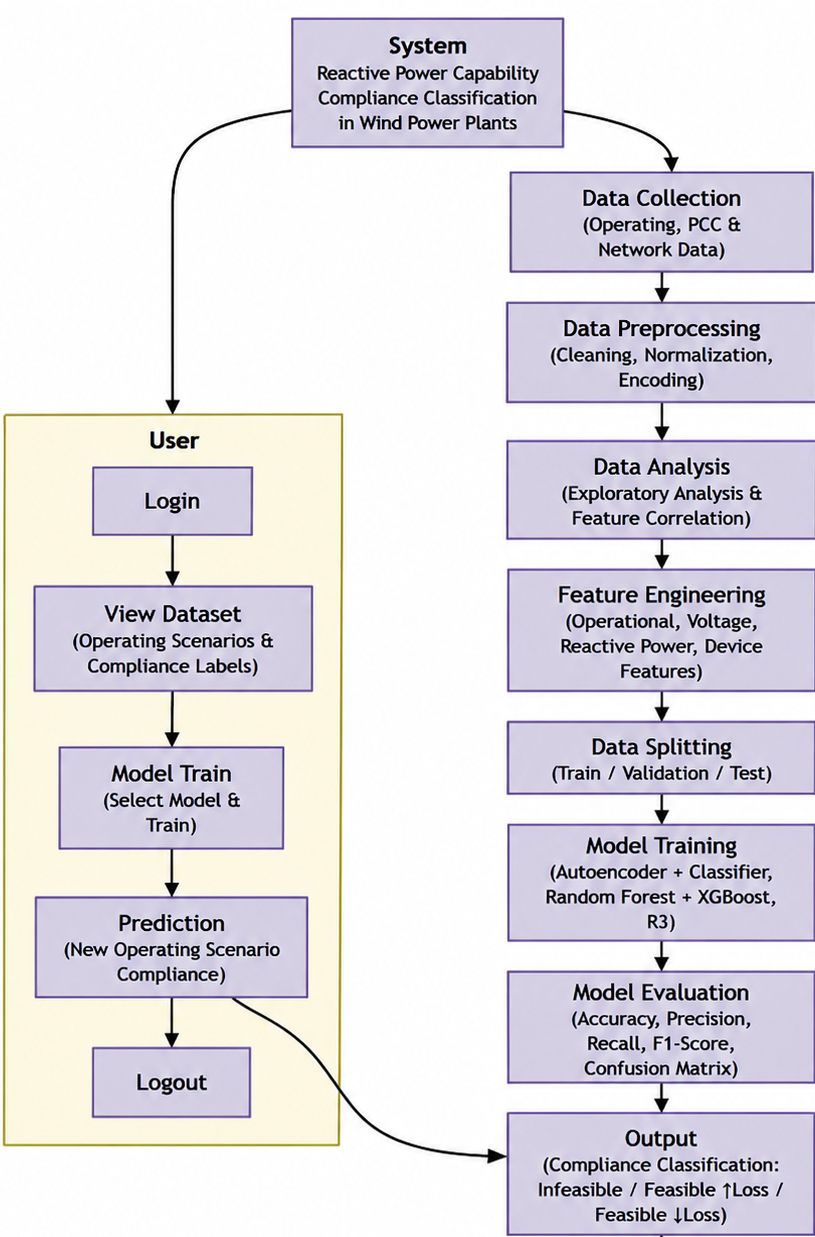
Block Diagram
Specifications
3.1 SOFTWARE REQUIREMENS
Operating System : Windows 7/8/10
Server side Script : HTML, CSS, Bootstrap & JS
Programming Language : Python
Libraries : Flask,Torch, Keras, Pandas,Json, , Numpy , Seaborn
IDE/Workbench : VSCode
Server Deployment : Xampp Server
Database : SQLite
3.2 HARDWARE REQUIREMENTS
Processor - I3/Intel Processor
RAM - 8GB (min)
Hard Disk - 128 GB
Key Board - Standard Windows Keyboard
Mouse - Two or Three Button Mouse
Monitor - Any

Demo Video


Request for Video
 Paper Publishing
Request Call Back
Would you like to receive a free callback now?
Choose the best time for callback:
Leave your message and we will contact you as soon as possible

6-2-85/B, Old Maternity Hospital Road, Thyagaraja Nagar, Tirupati, Andhra Pradesh – 517501
+91 9030333433
+91 9393939065
0877-2261612

Disclaimer - Takeoff Edu Group Projects are not associated or affiliated with IEEE in any way. The IEEE Projects mentioned here are mentioned in the context of student projects, whose ideas are derived from IEEE publications, not projects of or by IEEE.

