Machine Learning-Based Solar Power Forecasting for Improved Grid Reliability
Objective
We are predicting the generated solar power based on weather features such as temperature, humidity, wind speed, and radiation. The algorithm used for prediction is LightGBM .
Abstract
The global shift towards renewable energy sources, particularly solar energy, is driven by the growing need for sustainable and clean power generation. Solar energy, being abundant and environmentally friendly, plays a pivotal role in reducing carbon footprints and combating climate change. However, despite its potential, solar energy generation is inherently variable, depending on weather conditions like sunlight intensity, temperature, cloud cover, and wind speed. This variability poses significant challenges to its integration into the energy grid, as power fluctuations can lead to inefficiencies in energy distribution, especially when demand is unpredictable.
Accurate forecasting of solar
energy generation is crucial for ensuring grid stability, reducing energy
wastage, and optimizing the use of solar power. Traditional forecasting
methods, including statistical models like linear regression, often fail to
capture the complex, non-linear relationships between weather variables and
energy production. As a result, the predictions provided by these systems can
be imprecise, which hampers efficient grid management and the reliable utilization
of solar power.
NOTE: Without the concern of our team, please don't submit to the college. This Abstract varies based on student requirements.
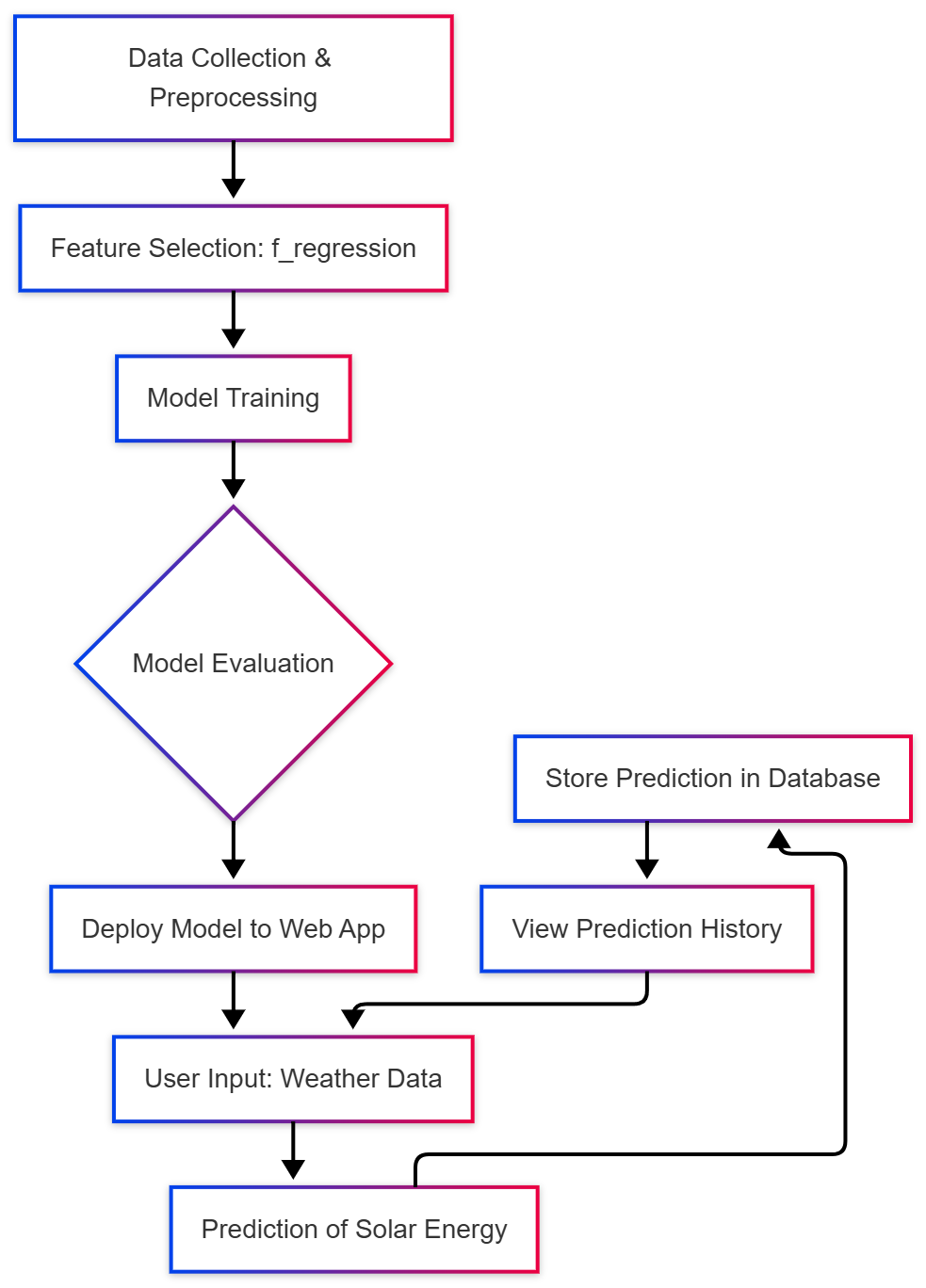
Block Diagram
Specifications
SOFTWARE REQUIREMENS
Operating System : Windows 7/8/10
Server side Script : HTML, CSS, Bootstrap & JS
Programming Language : Python
Libraries :Flask, Pandas, Torch, Sklearn, Librosa,Numpy , Seaborn, Matplotlib
IDE/Workbench : VSCode
Server Deployment : Xampp Server
Database : MySQL
HARDWARE REQUIREMENTS
Processor - I3/Intel Processor
RAM - 8GB (min)
Hard Disk - 128 GB
Key Board - Standard Windows Keyboard
Mouse - Two or Three Button Mouse
Monitor - Any


 Paper Publishing

Request Call Back
Would you like to receive a free callback now?
Choose the best time for callback:
Leave your message and we will contact you as soon as possible

6-2-85/B, Old Maternity Hospital Road, Thyagaraja Nagar, Tirupati, Andhra Pradesh – 517501
+91 9030333433
+91 9393939065
0877-2261612

Disclaimer - Takeoff Edu Group Projects are not associated or affiliated with IEEE in any way. The IEEE Projects mentioned here are mentioned in the context of student projects, whose ideas are derived from IEEE publications, not projects of or by IEEE.

