Machine Learning Based Recommendation System for Android Apps
Objective
The primary goal of this project is to develop a recommender system which will recommend the android app to the user. We have implemented the unsupervised machine learning content based collaborative filtering to build the recommendation system
Abstract
The application suggestion function in current Android systems is an essential tool that users may utilise to discover a similar application to replace a targeted one. The present recommendation algorithm supplied by Google and the Google Play store supposedly suggests apps comparable to a target application while taking into account each application's popularity. However, it does not take into account the security aspects of each programme or the user's choices when doing so. A large amount and different types of mobile applications (or apps) are being offered to end users via app markets. These apps normally generate network traffic, which will consumes users' mobile data plan and may even cause potential security issues. However, the amount and type of network traffic generated by a mobile app in the wild is still poorly understood due to the lack of a systematic measurement methodology. In this paper, we first measure and analyze network traffic cost of Android apps in the official Android markets. Based on the results, we find that the apps from different categories have different traffic costs. In particular, there is a remarkable difference among the apps with similar functionality in terms of network traffic cost. Then, we add metrics of traffic cost into our app recommendation algorithm, which differs from the conventional app recommendation approaches. Experimental results show that the proposed recommendation algorithm can effectively help mobile app users avoid various potential security and privacy risks brought by the unnecessary network traffic consumption.
Keywords: Unsupervised Machine Learning, Recommendation System, Content Based Filtering.
NOTE: Without the concern of our team, please don't submit to the college. This Abstract varies based on student requirements.
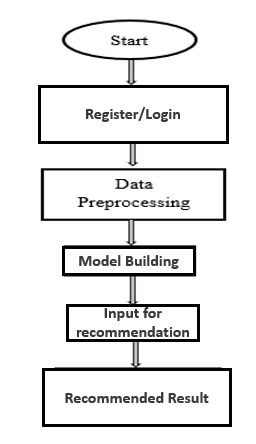
Block Diagram
Specifications
Hardware:
- Operating system: Windows 7 or 7+
- RAM: 8 GB
- Hard disc or SSD: More than 500 GB
- Processor: Intel 3rd generation or high or Ryzen with 8 GB Ram
Software:
Software’s: Python 3.6 or high version
IDE: PyCharm.
Framework :Flask
Learning Outcomes
· Practical exposure to
· Hardware and software tools
· Solution providing for real time problems
· Working with team/individual
· Work on creative ideas
· Testing techniques
· Error correction mechanisms
· What type of technology versions is used?
· Working of Tensor Flow
· Implementation of Deep Learning techniques
· Working of CNN algorithm
· Working of Transfer Learning methods
· Building of model creations
· Scope of project
· Applications of the project
· About Python language
· About Deep Learning Frameworks
Use of Data Science


 Paper Publishing

Request Call Back
Would you like to receive a free callback now?
Choose the best time for callback:
Leave your message and we will contact you as soon as possible

6-2-85/B, Old Maternity Hospital Road, Thyagaraja Nagar, Tirupati, Andhra Pradesh – 517501
+91 9030333433
+91 9393939065
0877-2261612

Disclaimer - Takeoff Edu Group Projects are not associated or affiliated with IEEE in any way. The IEEE Projects mentioned here are mentioned in the context of student projects, whose ideas are derived from IEEE publications, not projects of or by IEEE.

