Machine Learning-Based Prediction of Subsurface Elastic Properties Using Seismic and Well-Log Data
Objective
Machine Learning-Based Prediction of Subsurface Elastic Properties Using Seismic and Well-Log Data aims to develop an intelligent system for accurately estimating key elastic parameters such as Young’s modulus, Poisson’s ratio, and shear modulus in the subsurface. By integrating seismic attributes with high-resolution well-log measurements, machine learning models learn complex nonlinear relationships that traditional methods often miss. The system enhances reservoir characterization, improves drilling safety, and supports geomechanical modeling. With algorithms like Random Forest, XGBoost, or Neural Networks, the model provides reliable predictions even in data-sparse regions, making it valuable for exploration, production optimization, and decision-making in petroleum geoscience.
Abstract
Accurate prediction of subsurface rock properties is critical for safe and efficient drilling, reservoir management, and geomechanical analysis in the oil and gas industry. Traditional laboratory and field-based measurements are often expensive, time-consuming, and limited in spatial coverage, creating a need for automated, high-accuracy predictive approaches. The motive of this project is to leverage machine learning techniques to predict key subsurface elastic properties, such as Young’s modulus, from seismic and well-log data, thereby enabling faster, cost-effective, and reliable decision-making in reservoir engineering. In this study, rock subsurface properties are carefully processed and normalized, ensuring high-quality input for predictive modeling. The framework integrates multiple regression models, including Random Forest, XGBoost, LightGBM, MLP, and Linear Regression, to estimate elastic parameters from well-log features like RLL3, SP, MN, MI, MCAL, DCAL, RHOB, RHOC, and DPOR. A Flask-based web interface facilitates interactive dataset upload, real-time predictions, and visualization of results, offering intuitive insights into subsurface mechanical behavior. Predictions are classified into quintile-based categories from “Very Low” to “Very High,” with actionable recommendations for drilling and reservoir management. Comparative evaluation using MSE, RMSE, MAE, and R² metrics demonstrates that ensemble models, particularly LightGBM and Random Forest, achieve superior predictive performance. By combining machine learning, data preprocessing, and automated predictive modeling, this approach enhances efficiency, accuracy, and safety in subsurface exploration while reducing reliance on labor-intensive measurements.
Keywords: Machine Learning, Subsurface Elastic Properties, Seismic Data, Well-Log Analysis, Rock Property Processing, LightGBM, Random Forest, Reservoir Characterization, Geomechanical Analysis, Predictive Modeling
NOTE: Without the concern of our team, please don't submit to the college. This Abstract varies based on student requirements.
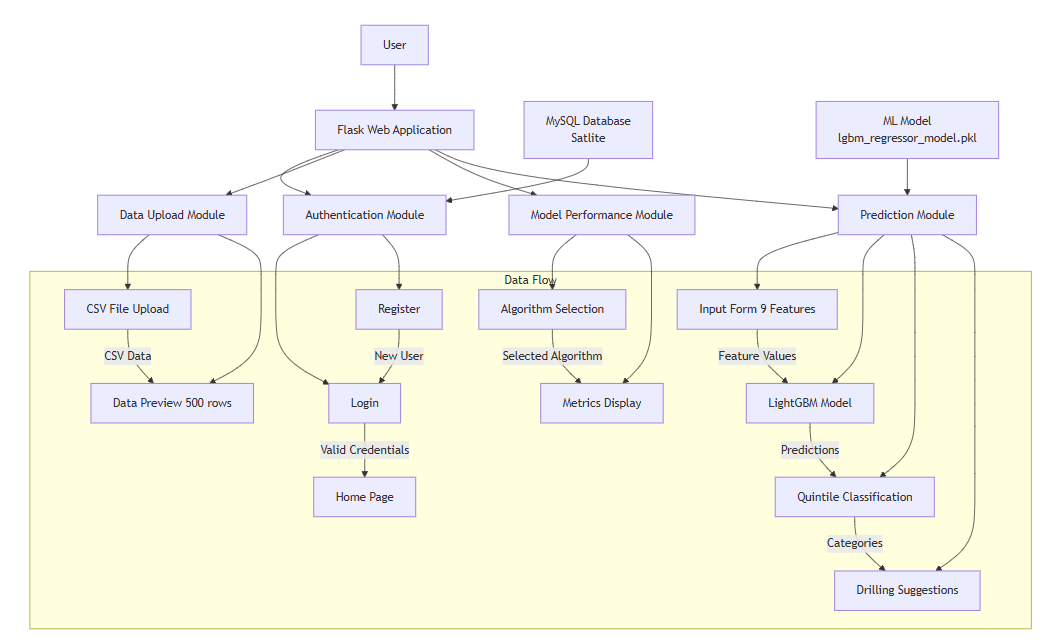
Block Diagram
Specifications
SOFTWARE REQUIREMENS
Operating System : Windows 7/8/10
Server side Script : HTML, CSS, Bootstrap & JS
Programming Language : Python
Libraries : Flask, Pandas, Torch, Keras, Sklearn, Numpy , Seaborn
IDE/Workbench : VSCODE
Server Deployment : Xampp Server
Database : MySQL
HARDWARE REQUIREMENTS
Processor - I3/Intel Processor
RAM - 8GB (min)
Hard Disk - 128 GB
Key Board - Standard Windows Keyboard
Mouse - Two or Three Button Mouse
Monitor - Any


 Paper Publishing

Request Call Back
Would you like to receive a free callback now?
Choose the best time for callback:
Leave your message and we will contact you as soon as possible

6-2-85/B, Old Maternity Hospital Road, Thyagaraja Nagar, Tirupati, Andhra Pradesh – 517501
+91 9030333433
+91 9393939065
0877-2261612

Disclaimer - Takeoff Edu Group Projects are not associated or affiliated with IEEE in any way. The IEEE Projects mentioned here are mentioned in the context of student projects, whose ideas are derived from IEEE publications, not projects of or by IEEE.

