Machine Learning-Based Life Expectancy Prediction in Developed and Developing Regions
Objective
The main goal of this project is to develop a machine learning framework to predict life expectancy across different regions using diverse health, socio-economic, and demographic features. The process involves collecting and preprocessing data from multiple countries and years to ensure accuracy and consistency. Various regression algorithms, including Linear Regression, Random Forest, XGBoost, Gradient Boosting, Stacking Regressor, and Voting Regressor, are implemented for comparative analysis. Models are evaluated using appropriate metrics to determine prediction accuracy. A Flask-based interface is developed for user interaction, allowing input of feature values and generating predictions, while key feature influences are analyzed to provide valuable insights.
Abstract
The project focuses on predicting life expectancy across developed and developing regions using machine learning techniques. Accurate life expectancy prediction can provide insights into public health, socio-economic conditions, and resource allocation. The dataset utilized contains features such as country, year, health indicators, socio-economic factors, and demographic statistics. Several regression algorithms, including Linear Regression, Random Forest, XGBoost, Gradient Boosting, Stacking Regressor, and Voting Regressor, are implemented to model and predict life expectancy. The performance of each algorithm is evaluated using suitable metrics to determine accuracy and reliability. Additionally, a Flask-based web interface is developed, enabling users to input data and obtain predictions efficiently. This framework can assist researchers and analysts in understanding health trends across regions. The study demonstrates the potential of machine learning in analyzing large datasets and deriving meaningful insights for life expectancy prediction.
Keywords: life expectancy, prediction, machine learning, linear regression, random forest, XGBoost, gradient boosting, stacking regressor, voting regressor, health analytics
NOTE: Without the concern of our team, please don't submit to the college. This Abstract varies based on student requirements.
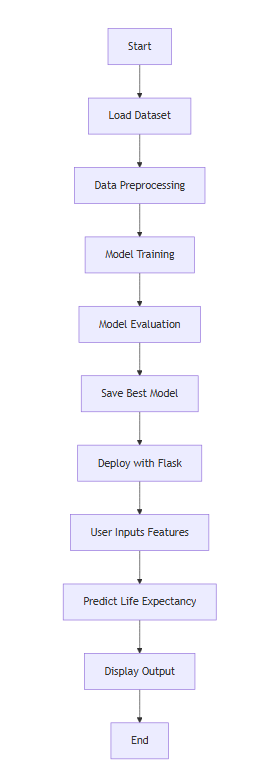
Block Diagram
Specifications
H/W CONFIGURATION:
Processor - I3/Intel Processor
Hard Disk - 160GB
Key Board - Standard Windows Keyboard
Mouse - Two or Three Button Mouse
Monitor - SVGA
RAM - 8GB
S/W CONFIGURATION:
• Operating System : Windows 7/8/10
• Server side Script : HTML, CSS, Bootstrap & JS
• Programming Language : Python
• Libraries : Flask, Pandas, MySQL. Connector, Scikit-Learn, pytorch
• IDE/Workbench : VS Code
• Technology : Python 3.8+
• Server Deployment : Xampp Server


 Paper Publishing

Request Call Back
Would you like to receive a free callback now?
Choose the best time for callback:
Leave your message and we will contact you as soon as possible

6-2-85/B, Old Maternity Hospital Road, Thyagaraja Nagar, Tirupati, Andhra Pradesh – 517501
+91 9030333433
+91 9393939065
0877-2261612

Disclaimer - Takeoff Edu Group Projects are not associated or affiliated with IEEE in any way. The IEEE Projects mentioned here are mentioned in the context of student projects, whose ideas are derived from IEEE publications, not projects of or by IEEE.

