Machine Learning Based Diagnostic Paradigm in Viral and Non-Viral Hepatocellular Carcinoma
Objective
The objective of this project is to leverage machine learning algorithms to enhance the diagnostic accuracy of hepatocellular carcinoma (HCC) by distinguishing between viral and non-viral types. The project involves developing and implementing several classification models, including Logistic Regression, Random Forest, Decision Tree, XGBoost, and AdaBoost, and evaluating their performance using a dataset of 204 samples with 50 features. The aim is to assess the effectiveness of these models in improving diagnostic precision compared to traditional methods. By comparing model accuracy and other performance metrics, the project seeks to identify the most reliable algorithm for HCC classification. The ultimate goal is to advance the application of machine learning in oncology, providing valuable insights for clinical decision-making and contributing to more effective and accurate diagnostic practices for hepatocellular carcinoma.
Abstract
This study investigates the application of machine learning (ML) techniques for distinguishing viral and non-viral hepatocellular carcinoma (HCC), aiming to enhance diagnostic precision in clinical oncology. A comprehensive dataset comprising 204 patient records and 50 diverse features, including demographic, clinical, and laboratory parameters, was utilized to train and evaluate several classification algorithms, including Logistic Regression, Random Forest, Decision Tree, XGBoost, and AdaBoost. The study highlights differences in the performance of these algorithms, with ensemble-based methods demonstrating notable robustness in identifying complex patterns within the dataset. The findings suggest that machine learning approaches can significantly support clinicians in improving diagnostic accuracy, facilitating early detection, and informing personalized treatment strategies for HCC patients. This research underscores the potential of advanced ML methods to enhance decision-making processes in oncology by leveraging computational intelligence for more precise and efficient disease classification. Overall, the study provides a foundation for integrating machine learning into clinical workflows, emphasizing its role in advancing the diagnosis and management of both viral and non-viral forms of hepatocellular carcinoma.
Keywords: Machine Learning, Hepatocellular Carcinoma (HCC), Viral vs. Non-Viral Diagnosis, Classification Algorithms, Logistic Regression, Random Forest, Decision Tree, XGBoost, AdaBoost, Diagnostic Accuracy.
NOTE: Without the concern of our team, please don't submit to the college. This Abstract varies based on student requirements.
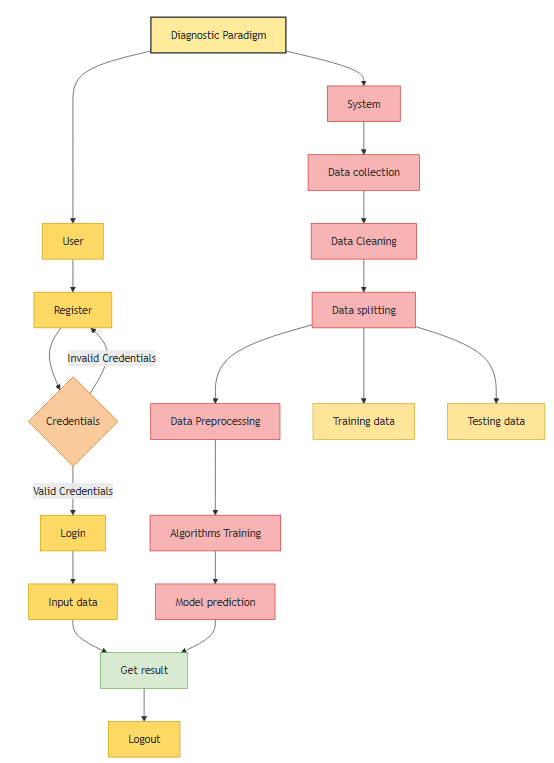
Block Diagram
Specifications
H/W CONFIGURATION:
Processor - I3/Intel Processor
Hard Disk - 160GB
Key Board - Standard Windows Keyboard
Mouse - Two or Three Button Mouse
Monitor - SVGA
RAM - 8GB
S/W CONFIGURATION:
• Operating System : Windows 7/8/10
• Server side Script : HTML, CSS, Bootstrap & JS
• Programming Language : Python
• Libraries : Flask, Pandas, MySQL. Connector, Scikit-Learn
• IDE/Workbench : VS Code
• Technology : Python 3.8+
• Server Deployment : Xampp Server


 Paper Publishing

Request Call Back
Would you like to receive a free callback now?
Choose the best time for callback:
Leave your message and we will contact you as soon as possible

6-2-85/B, Old Maternity Hospital Road, Thyagaraja Nagar, Tirupati, Andhra Pradesh – 517501
+91 9030333433
+91 9393939065
0877-2261612

Disclaimer - Takeoff Edu Group Projects are not associated or affiliated with IEEE in any way. The IEEE Projects mentioned here are mentioned in the context of student projects, whose ideas are derived from IEEE publications, not projects of or by IEEE.

