Machine Learning Based Diagnostic Paradigm in Viral and Non-Viral Hepatocellular Carcinoma
Objective
The primary objective of this project is to develop a robust machine learning-based diagnostic tool to accurately classify hepatocellular carcinoma (HCC) into viral and non-viral categories.
Abstract
Hepatocellular carcinoma (HCC) is a common and aggressive form of liver cancer, and accurate diagnosis is critical for effective treatment and patient management. This project focuses on developing a machine learning-based diagnostic paradigm to distinguish between viral and non-viral HCC cases using a comprehensive dataset from Kaggle. The dataset, which includes balanced cases of HCC, serves as the foundation for our analysis. We employ several classification algorithms to achieve this, including Decision Tree (DT), Random Forest (RF), Logistic Regression (LR), and a Stacking Classifier. Each algorithm is evaluated for its performance in accurately classifying the type of HCC, with the goal of identifying the most effective method for diagnosis. The Stacking Classifier, which combines multiple models to improve predictive accuracy, is of particular interest in this study. By comparing the results of these models, we aim to enhance diagnostic precision, support personalized treatment plans, and ultimately contribute to better patient outcomes. This project seeks to address the limitations of traditional diagnostic methods and provide a robust tool for clinicians to differentiate between viral and non-viral HCC effectively.
Keywords: Hepatocellular carcinoma, Machine learning, Classification, Viral HCC, Non-viral HCC, Decision Tree, Random Forest, Logistic Regression, Stacking Classifier, Diagnostic accuracy
NOTE: Without the concern of our team, please don't submit to the college. This Abstract varies based on student requirements.
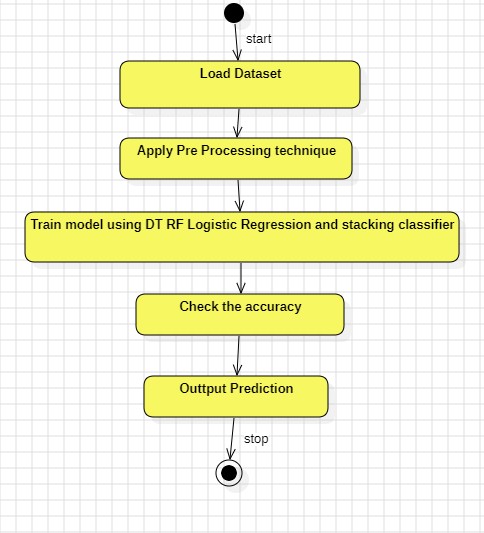
Block Diagram
Specifications
Hardware Requirements:
Operating system : Windows 7 or 7+
RAM : 8 GB
Hard disc or SSD : More than 500 GB
Processor : Intel 3rd generation or high or Ryzen with 8 GB Ram
Software Requirements:
Software’s : Python 3.10 or high version
IDE : Visual Studio Code.
Framework : Flask

Demo Video


Request for Video
 Paper Publishing
Request Call Back
Would you like to receive a free callback now?
Choose the best time for callback:
Leave your message and we will contact you as soon as possible

6-2-85/B, Old Maternity Hospital Road, Thyagaraja Nagar, Tirupati, Andhra Pradesh – 517501
+91 9030333433
+91 9393939065
0877-2261612

Disclaimer - Takeoff Edu Group Projects are not associated or affiliated with IEEE in any way. The IEEE Projects mentioned here are mentioned in the context of student projects, whose ideas are derived from IEEE publications, not projects of or by IEEE.

