Machine Learning Based Diagnosis of Lumpy Skin Disease
Objective
The main objective of the Machine Learning Based Diagnosis of Lumpy Skin Disease is to accurately predict whether a person is affected by the disease or not. By leveraging machine learning algorithms and analyzing relevant data, the goal is to provide an efficient and reliable diagnostic tool for identifying lumpy skin disease in individuals. This predictive model aims to aid healthcare professionals in making early and informed decisions for timely treatment and containment of the disease.
Abstract
Lumpy Skin Disease (LSD) is a highly contagious viral infection that affects cattle and poses a significant threat to the livestock industry worldwide. Rapid and accurate diagnosis of LSD is crucial for controlling its spread and preventing economic losses. Traditional diagnostic methods, such as clinical observation and laboratory testing, are time-consuming and may lack sensitivity. In recent years, machine learning (ML) has emerged as a powerful tool for medical diagnosis, offering the potential for faster and more reliable detection of diseases. This paper presents a novel approach for the diagnosis of Lumpy Skin Disease using machine learning techniques. We collected a comprehensive dataset of clinical and histopathological s of cattle affected by LSD, along with data from healthy cattle for comparison. The dataset was preprocessed to remove noise and standardized for analysis.The advantages of our ML-based diagnosis system are twofold. Firstly, it offers a rapid and non-invasive method for detecting LSD, significantly reducing the time required for diagnosis compared to traditional methods. This speed is crucial for implementing timely control measures and preventing the spread of the disease. Secondly, the system's high accuracy ensures reliable results, reducing the risk of misdiagnosis and associated economic losses. The system has the potential to revolutionize the way LSD is detected and managed, contributing to the health and productivity of cattle populations worldwide while safeguarding the livestock industry against this devastating disease.
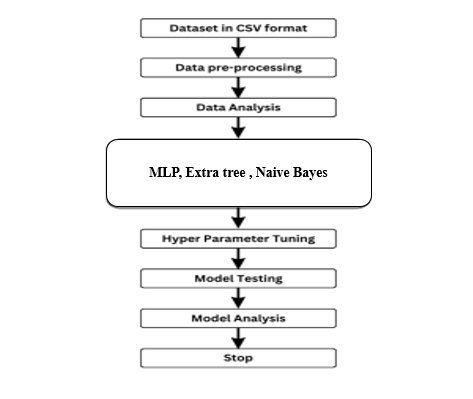
Keywords: MLP, Extra tree, Naïve baye’s, evaluation, ml techniques.
NOTE: Without the concern of our team, please don't submit to the college. This Abstract varies based on student requirements.
Block Diagram
Specifications
H/W CONFIGURATION:
Processor - I5/Intel Processor
Hard Disk - 160GB
Key Board - Standard Windows Keyboard
Mouse - Two or Three Button Mouse
Monitor - SVGA
RAM - 8GB
S/W CONFIGURATION:
• Operating System : Windows 7/8/10
• Server side Script : HTML, CSS, Bootstrap & JS
• Programming Language : Python
• Libraries : Flask, Pandas, Mysql.connector,Numpy
• IDE/Workbench : PyCharm
• Technology : Python 3.6+
• Server Deployment : Xampp Server


 Paper Publishing

Request Call Back
Would you like to receive a free callback now?
Choose the best time for callback:
Leave your message and we will contact you as soon as possible

6-2-85/B, Old Maternity Hospital Road, Thyagaraja Nagar, Tirupati, Andhra Pradesh – 517501
+91 9030333433
+91 9393939065
0877-2261612

Disclaimer - Takeoff Edu Group Projects are not associated or affiliated with IEEE in any way. The IEEE Projects mentioned here are mentioned in the context of student projects, whose ideas are derived from IEEE publications, not projects of or by IEEE.

