Machine Learning-Based Cellular Traffic Prediction Using Data Reduction Techniques
Objective
Develop an advanced framework for predicting cellular traffic load using Random Forest, XGBoost, and Stacking Classifier, focusing on accuracy, reduced complexity, and enhanced network management for better QoS.
Abstract
Cellular networks are experiencing unprecedented growth in data traffic due to the widespread use of smartphones and streaming services, necessitating effective traffic prediction for maintaining Quality of Service (QoS). This project aims to develop a robust framework for predicting cellular traffic load using machine learning techniques, focusing on data reduction and model efficiency. The existing system employs LightGBM, Support Vector Machine (SVM), Linear Regression (LR), and DBSCAN clustering. The proposed system introduces Random Forest, XGBoost, and a Stacking Classifier to enhance prediction accuracy and reduce computational complexity. The dataset comprises comprehensive features such as user throughput, cell throughput, latency, resource block utilization, and more, collected from real cellular networks. Data preprocessing steps include handling missing values, normalization, and Principal Component Analysis (PCA) for dimensionality reduction. DBSCAN clustering is applied to group similar traffic patterns, improving the efficiency of the prediction models. The performance of the proposed models is evaluated against existing models using metrics such as Mean Squared Error (MSE). Initial results indicate that the proposed models, particularly the Stacking Classifier, outperform the existing models in terms of accuracy and computational efficiency. This project demonstrates the potential of advanced machine learning techniques and data reduction strategies in optimizing cellular traffic prediction, ultimately contributing to better network management and resource allocation.
Keywords: Cellular Traffic Prediction, Machine Learning, Data Reduction Techniques.
NOTE: Without the concern of our team, please don't submit to the college. This Abstract varies based on student requirements.
Block Diagram
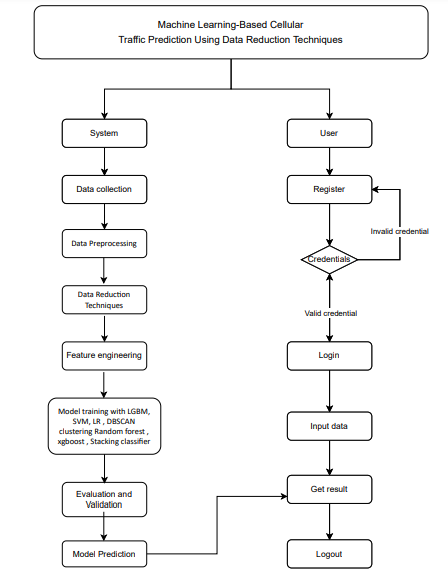
Specifications
H/W CONFIGURATION:
Processor - I3/Intel Processor
Hard Disk - 160GB
Key Board - Standard Windows Keyboard
Mouse - Two or Three Button Mouse
Monitor - SVGA
RAM - 8GB
S/W CONFIGURATION:
• Operating System : Windows 7/8/10
• Server side Script : HTML, CSS, Bootstrap & JS
• Programming Language : Python
• Libraries : Flask, Pandas, Mysql.connector, Os, Scikit-learn, Numpy
• IDE/Workbench : PyCharm
• Technology : Python 3.6+
• Server Deployment : Xampp Server


 Paper Publishing

Request Call Back
Would you like to receive a free callback now?
Choose the best time for callback:
Leave your message and we will contact you as soon as possible

6-2-85/B, Old Maternity Hospital Road, Thyagaraja Nagar, Tirupati, Andhra Pradesh – 517501
+91 9030333433
+91 9393939065
0877-2261612

Disclaimer - Takeoff Edu Group Projects are not associated or affiliated with IEEE in any way. The IEEE Projects mentioned here are mentioned in the context of student projects, whose ideas are derived from IEEE publications, not projects of or by IEEE.

