Machine and Deep Learning Models for Stress Detection Using Multimodal Physiological Data
Objective
To develop and evaluate machine and deep learning models for accurately classifying stress levels using multimodal physiological signals. The goal is to enhance real-time stress detection for mental health monitoring by comparing the effectiveness of MLP, Random Forest, Decision Tree, and Logistic Regression.
Abstract
Stress detection is a critical component in modern healthcare and wellness systems, especially for identifying mental health issues before they escalate. This study presents a comprehensive comparison of various machine and deep learning models for stress detection using multimodal physiological data. We investigate classical machine learning models including Logistic Regression (LR), Gaussian Naïve Bayes (GaussianNB), AdaBoost Classifier (AB), XGBoost Classifier (XGBoost), Decision Trees Classifier (Decision Trees), Extra Trees Classifier (Extra Trees), and Random Forest Classifier (Random Forest). In addition, we explore deep learning approaches such as Deep Neural Network (DNN), Convolutional Neural Network (CNN), and Recurrent Neural Network (RNN), along with advanced ensemble techniques like Stacking Classifier and Voting Classifier. The models were evaluated based on their accuracy, precision, recall, and F1-score using a diverse physiological dataset containing variables such as heart rate, skin conductance, and respiratory rate. Our findings provide insights into the performance of these models in detecting stress from physiological signals, demonstrating the potential of both classical and deep learning techniques in healthcare applications. The results suggest that while deep learning models like CNN, RNN, and LSTM offer higher accuracy, ensemble methods like Stacking and Voting Classifiers enhance the robustness of the predictions.
Keywords:
Stress detection, machine learning, deep learning, multimodal physiological
data, Logistic Regression, Gaussian Naïve Bayes, AdaBoost, XGBoost, Decision
Trees, Extra Trees, Random Forest, Deep Neural Network, Convolutional Neural
Network, Recurrent Neural Network, Stacking Classifier, Voting Classifier,
LSTM, ensemble methods, healthcare.
NOTE: Without the concern of our team, please don't submit to the college. This Abstract varies based on student requirements.
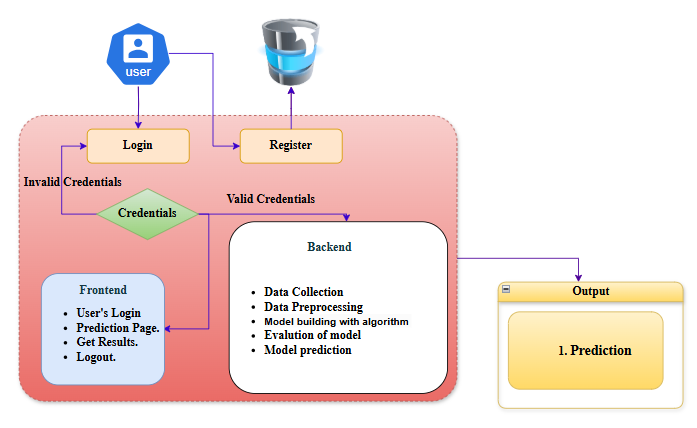
Block Diagram
Specifications
Hardware and Software Requirements
- Processor: Intel Core i5 or above / AMD Ryzen 5 or higher
- RAM: Minimum 8 GB (Recommended 16 GB for faster model training)
- Storage: At least 256 GB SSD (Recommended 512 GB SSD for faster I/O operations)
- Display: Standard HD Monitor (1920×1080 resolution recommended)
- Peripherals: Keyboard, Mouse
- Optional: GPU (e.g., NVIDIA with CUDA support) for faster training on large datasets
Software Requirements
The software environment must support machine learning, web development, and database connectivity. The recommended stack includes:
- Operating System: Windows 10/11, Linux (Ubuntu 20.04+), or macOS
- Programming Language: Python 3.8 or above
- Frontend Framework: HTML5, CSS3, JavaScript (Bootstrap for styling)
- Backend Framework: Flask (Python-based lightweight web framework)
- Database: MySQL (for user, dataset, and result storage)
- Machine Learning Libraries:
- scikit-learn (for Random Forest, Linear Regression, DTR, GBR, XGBR)
- pandas, numpy (for data manipulation and numerical computation)
- matplotlib / seaborn (for data visualization)
- IDE/Tools:
- Jupyter Notebook / VS Code / PyCharm
- MySQL Workbench for database management
- Server Deployment (optional): Apache / Nginx, or use services like Heroku or AWS EC2 for hosting.

Demo Video


Request for Video
 Paper Publishing
Request Call Back
Would you like to receive a free callback now?
Choose the best time for callback:
Leave your message and we will contact you as soon as possible

6-2-85/B, Old Maternity Hospital Road, Thyagaraja Nagar, Tirupati, Andhra Pradesh – 517501
+91 9030333433
+91 9393939065
0877-2261612

Disclaimer - Takeoff Edu Group Projects are not associated or affiliated with IEEE in any way. The IEEE Projects mentioned here are mentioned in the context of student projects, whose ideas are derived from IEEE publications, not projects of or by IEEE.

