Lung Cancer Prediction using Machine Learning
Objective
The primary objective of this project is to develop a reliable machine learning model for predicting lung cancer risk levels—categorized as High, Medium, or Low—based on patient data. By leveraging algorithms such as Random Forest, XGBoost, and Voting Classifier, the project aims to achieve high accuracy and robustness in predictions. This model is designed to assist healthcare professionals in early detection, enabling timely interventions and personalized treatment plans. Additionally, the project seeks to optimize machine learning techniques through data preprocessing, feature selection, and hyperparameter tuning to enhance predictive performance. Ultimately, the goal is to integrate the system into healthcare platforms, providing an accessible and efficient tool for improving patient outcomes and advancing cancer diagnostics.
Abstract
Abstract:
Lung cancer remains a leading cause of mortality, emphasizing the need for
early risk assessment and diagnosis. This project, "Lung Cancer
Prediction Using Machine Learning," classifies lung cancer risk
into three categories: High, Medium, and Low
using advanced algorithms like Random Forest, XG Boost,
and a Voting Classifier. The model is trained on clinical and
pathological data, optimized for accuracy through feature selection and hyper
parameter tuning. Developed using Python, the system integrates a robust
backend to ensure reliable predictions. The aim is to assist healthcare
professionals in early detection and personalized treatment planning. This
project demonstrates the potential of machine learning in enhancing lung cancer
diagnosis and management.
NOTE: Without the concern of our team, please don't submit to the college. This Abstract varies based on student requirements.
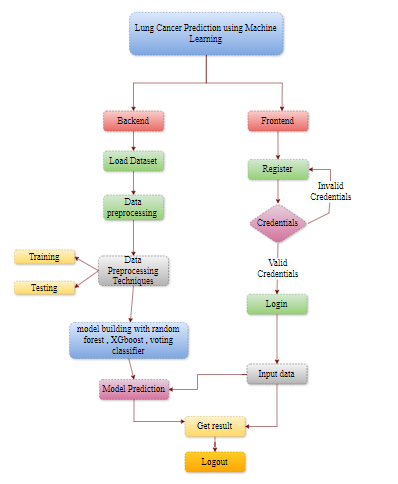
Block Diagram
Specifications
HARWARE AND SIFTWARE REQUIREMENT
Hardware Configuration
- Processor: Intel i3/Intel Processor
- Hard Disk: 160GB
- Keyboard: Standard Windows Keyboard
- Mouse: Two or Three Button Mouse
- Monitor: SVGA
- RAM: 8GB
- Operating System: Windows 7/8/10
- Server-Side Script: HTML, CSS, Bootstrap, JavaScript
- Programming Language: Python
- Libraries: Flask, Pandas, MySQL. Connector, Os, Smtplib, Numpy
- IDE/Workbench: PyCharm
- Technology: Python 3.6+
- Server Deployment: XAMPP Server


 Paper Publishing

Request Call Back
Would you like to receive a free callback now?
Choose the best time for callback:
Leave your message and we will contact you as soon as possible

6-2-85/B, Old Maternity Hospital Road, Thyagaraja Nagar, Tirupati, Andhra Pradesh – 517501
+91 9030333433
+91 9393939065
0877-2261612

Disclaimer - Takeoff Edu Group Projects are not associated or affiliated with IEEE in any way. The IEEE Projects mentioned here are mentioned in the context of student projects, whose ideas are derived from IEEE publications, not projects of or by IEEE.

