Low Power Hybrid Full Adder Design using MGDI Based XNOR Gate with Swing Restored Technique
Also Available Domains Nano Technology
Objective
This project presents a low-power hybrid full adder design using an MGDI-based XNOR gate with a swing restoration technique. The proposed architecture focuses on reducing power consumption and propagation delay while maintaining full voltage swing at the outputs. By employing Modified Gate Diffusion Input (MGDI) logic for the XNOR operation and incorporating swing restoration transistors, the design overcomes threshold voltage loss commonly observed in pass-transistor-based adders
Abstract
This project presents a low-power hybrid full adder design using an MGDI-based XNOR gate with a swing restoration technique. The proposed architecture focuses on reducing power consumption and propagation delay while maintaining full voltage swing at the outputs. By employing Modified Gate Diffusion Input (MGDI) logic for the XNOR operation and incorporating swing restoration transistors, the design overcomes threshold voltage loss commonly observed in pass-transistor-based adders. Simulation results show that the proposed full adder achieves lower power dissipation, reduced delay, and improved power–delay product (PDP) compared to conventional CMOS and hybrid full adder designs. Due to its energy-efficient operation and reliable output performance, the proposed design is well suited for low-voltage and high-performance VLSI applications.
KEYWORDS: FA (Full adder), CMOS, MGDI (Modified Gate Diffusion Input), VLSI, transmission gate (TG).
NOTE: Without the concern of our team, please don't submit to the college. This Abstract varies based on student requirements.
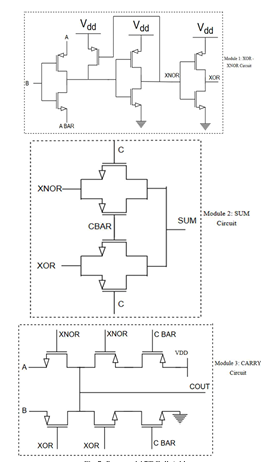
Block Diagram
Specifications
· Tool Used: Tanner EDA tools for schematic and simulation
· Technology Node: 250 CMOS process.
· Counter Width: 7-bit
· Design Elements: XNOR-XNOR BLOCK, SUM BLOCK , CARRY BLOCK
· Optimization Goal: Reduce power and area while maintaining full-swing outputs and low delay in MGDI-based hybrid full adder design.
Learning Outcomes
Understanding of MGDI logic and its advantages in low-power design
· Knowledge of XNOR-based full adder architectures
· Ability to analyze swing restoration techniques
· Experience in low-power VLSI arithmetic circuit design
· Insight into power, delay, and area trade-offs in hybrid logic circuits
Demo Video


Request for Video
 Paper Publishing
Request Call Back
Would you like to receive a free callback now?
Choose the best time for callback:
Leave your message and we will contact you as soon as possible

6-2-85/B, Old Maternity Hospital Road, Thyagaraja Nagar, Tirupati, Andhra Pradesh – 517501
+91 9030333433
+91 9393939065
0877-2261612

Disclaimer - Takeoff Edu Group Projects are not associated or affiliated with IEEE in any way. The IEEE Projects mentioned here are mentioned in the context of student projects, whose ideas are derived from IEEE publications, not projects of or by IEEE.

