Low Leakage Clock Tree with Dual-Threshold- Voltage Split Input–Output Repeaters
Also Available Domains Tanner EDA
Objective
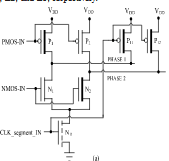
A novel dual-threshold voltage repeater circuit with divided inputs – outputs is used in this paper to inhibit leakage currents in gated CDNs.
Abstract
across the chip with signal transition times of less than or equal to 50 ps at the leaves. Depending on the power supply voltage and floor plan, the standby leakage power consumption is reduced by 50.36%–78.43% with the proposed clock tree with SPLIT-IO repeaters as compared to the conventional three-level H-tree in a 45-nm CMOS technology. The spread of standby leakage power
due to process variations is compressed by 36.72%–73.77% with the proposed clock tree as compared to the standard network. The proposed circuit technique significantly lowers the total energy consumption of partially active networks with local clock gating as well. The energy savings provided by the SPLIT-IO
buffers are enhanced with the scaling of power supply voltage and frequency in synchronous systems-on-chip.
NOTE: Without the concern of our team, please don't submit to the college. This Abstract varies based on student requirements.
Block Diagram
Specifications
Learning Outcomes
- Basics of Digital Electronics
- VLSI design Flow
- About approximation computing
- About Reversible logic
- Applications in real time
· Generation of Netlist
· Solution providing for real time problems
· Project Development Skills:
o Problem Analysis Skills
o Problem Solving Skills
o Logical Skills
o Designing Skills
o Testing Skills
o Debugging Skills
o Presentation Skills


 Paper Publishing

Request Call Back
Would you like to receive a free callback now?
Choose the best time for callback:
Leave your message and we will contact you as soon as possible

6-2-85/B, Old Maternity Hospital Road, Thyagaraja Nagar, Tirupati, Andhra Pradesh – 517501
+91 9030333433
+91 9393939065
0877-2261612

Disclaimer - Takeoff Edu Group Projects are not associated or affiliated with IEEE in any way. The IEEE Projects mentioned here are mentioned in the context of student projects, whose ideas are derived from IEEE publications, not projects of or by IEEE.

