Low-illumination Image Enhancement Algorithm Based on a Physical Lighting Model
Abstract
In this work, we present a physical lighting model that describes the degradation of poor illumination images, in which the environmental light is a point-wise variable and changes with the local light source. Low-illumination images are usually taken in non-uniform environmental light, such as extremely dark or bright light or artificial light. The enhancement results achieved by existing techniques are prone to halo artifacts, color un-naturalness, and information loss. To address these problems, we proposed our idea.
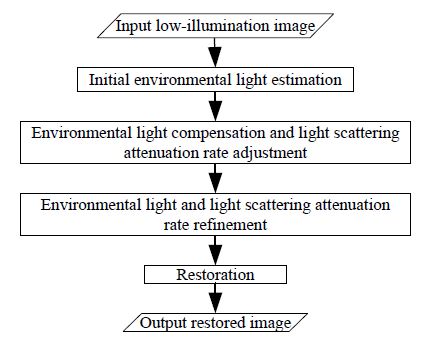
As long as the parameters in the model are properly estimated, the low-illumination images can be directly recovered by solving the model. First, the initial environmental light can be considered as the incident component according to the Retinex theory and estimated via a Gaussian surrounding function. Second, the environmental light and light-scattering attenuation rate are iteratively adjusted with the information loss constraint. Last, to re-strain the halo and block effects, the two parameters are refined by the weighted guide filter.
The experimental results indicate that the proposed algorithm can improve the appearance of low-illumination images that are captured in different scenes, reveal the details in textured regions with few halo effects, in-crease the richness of the visible edges, retain color consistency and reproduce the color quality and naturalness.
NOTE: Without the concern of our team, please don't submit to the college. This Abstract varies based on student requirements.
Block Diagram
Specifications

Contact Us
- info@takeoffprojects.com
- +91 9030333433, +91 9393939065


 Paper Publishing

Request Call Back
Would you like to receive a free callback now?
Choose the best time for callback:
Leave your message and we will contact you as soon as possible

6-2-85/B, Old Maternity Hospital Road, Thyagaraja Nagar, Tirupati, Andhra Pradesh – 517501
+91 9030333433
+91 9393939065
0877-2261612

Disclaimer - Takeoff Edu Group Projects are not associated or affiliated with IEEE in any way. The IEEE Projects mentioned here are mentioned in the context of student projects, whose ideas are derived from IEEE publications, not projects of or by IEEE.

