Low Cost Nano Satellite Communication System Using Arduino
Also Available Domains Arduino
Abstract
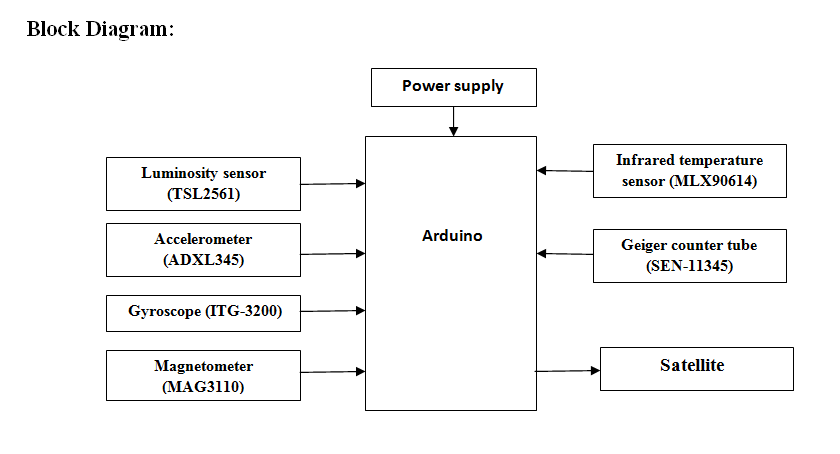
Short for “Arduino Satellite”, ArduSat is an open-source Nano satellite, based on the CubeSat standard. The extensive Arduino sensor suite on board gives the opportunity to create their own satellite experiments and collects real-world space data using the Arduino open-source prototyping platform. Hasselt University used the downloadable ArduSat Software Development Kit which allowed them to design the command sequences they used to conduct their experiments. ArduSat-X and ArduSat-1 are two single unit (1U) CubeSat, with sides of 10 cm and a total mass of approximately 1 kilogram. The tiny spacecraft’s structure and power subsystems are based on the CubeSat standard, an open-source specification created in 1999 which defines a standard platform for low-cost space research. Both satellites carry roughly 20 sensors, including an optical spectrometer and a camera. To communicate with the ground, ArduSat is equipped with a half-duplex UHF transceiver, operating in the 435-438 MHz amateur radio satellite band. The brain of the ArduSat-1 is the ArduSat Payload Processor Module (ASPPM). It features one supervisor processor consisting of anATmega2561 (similar to an Arduino Mega) plus 16 processor nodes each running an ATmega328P just like an Arduino Uno. In this project we used an Arduino Uno to upload their code because the processor nodes of the ASPPM in the ArduSat run a similar microcontroller. The whole idea behind the working process is to create code; submit code for review via email or through ArduSat website, do code testing on a development Satellite, upload the program to the satellite; download the resulting data from the satellite, and examine the gathered data. Seven sensors of the ArduSat sensor suite have been tested, the first six of them exactly the same as those in the original ArduSat sensor suite .
NOTE: Without the concern of our team, please don't submit to the college. This Abstract varies based on student requirements.
Block Diagram
Specifications


 Paper Publishing

Request Call Back
Would you like to receive a free callback now?
Choose the best time for callback:
Leave your message and we will contact you as soon as possible

6-2-85/B, Old Maternity Hospital Road, Thyagaraja Nagar, Tirupati, Andhra Pradesh – 517501
+91 9030333433
+91 9393939065
0877-2261612

Disclaimer - Takeoff Edu Group Projects are not associated or affiliated with IEEE in any way. The IEEE Projects mentioned here are mentioned in the context of student projects, whose ideas are derived from IEEE publications, not projects of or by IEEE.

