Low-complexity Continuous-flow Memory-Based FFT Architectures for Real-valued Signals
Also Available Domains Core Memories|Xilinx Vivado|Xilinx ISE
Objective
This paper presents two low-complexity continuous flow memory-based fast Fourier transform (FFT) architectures (Type-I, II) for real-valued signals.
Abstract
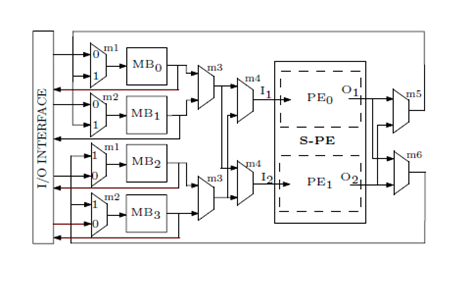
This paper presents two low-complexity continuousflow memory-based fast Fourier transform (FFT) architectures (Type-I, II) for real-valued signals. Both the proposed designs employ split processing-elements (SPEs), however Type-I SPE processes four inputs while Type-II SPE processes two inputs in parallel. The SPE in Type-I design contains a half-complex multiplier and that of Type-II design contains a quarter-complex multiplier. Two new memory accessing schemes corresponding to each design is proposed. Analysis of computational complexities for both the architectures are carried out and compared with
existing designs. It is found that Type-I architecture provides lowcomplexity
in terms of registers and multiplexers while Type-II architecture provides low-complexity in terms of the multiplier. Application specific integrated circuit (ASIC) synthesis and field programmable gate array (FPGA) implementation results show that the proposed designs offer low-area, low-power and utilize less logic elements. For instance, 32-point Type-I real FFT offer requires 5.06% less area, 15.1% less power, 6.58% less sliced look-up table (SLUT) and 5.25% less FF while Type-II 47.76% less area, 43.64% power, 48.22% less SLUT and 43.48% less FF over the best existing scheme.
NOTE: Without the concern of our team, please don't submit to the college. This Abstract varies based on student requirements.
Block Diagram
Specifications

Contact Us
- info@takeoffprojects.com
- +91 9030333433, +91 9393939065


 Paper Publishing

Request Call Back
Would you like to receive a free callback now?
Choose the best time for callback:
Leave your message and we will contact you as soon as possible

6-2-85/B, Old Maternity Hospital Road, Thyagaraja Nagar, Tirupati, Andhra Pradesh – 517501
+91 9030333433
+91 9393939065
0877-2261612

Disclaimer - Takeoff Edu Group Projects are not associated or affiliated with IEEE in any way. The IEEE Projects mentioned here are mentioned in the context of student projects, whose ideas are derived from IEEE publications, not projects of or by IEEE.

