Lightweight EfficientNetB3 Model Based on Deathwise Separable Convolutions for Enhancing Classification of Leukemia Blood Cell
Objective
The objective of the study is to develop a lightweight variant of the EfficientNetB3 architecture tailored for the automated detection of leukemia from white blood cell (WBC) images. This involves integrating depthwise separable convolutions to streamline model parameters and computations while preserving critical discriminative features. The research aims to curate a comprehensive dataset of WBC images annotated with leukemia subtypes and disease stages for thorough model training and evaluation. Through extensive experimentation and ablation studies, the study evaluates the efficacy of the proposed model in achieving competitive performance metrics such as accuracy, precision, and recall, compared to conventional architectures. Ultimately, the goal is to contribute to the advancement of efficient and accurate leukemia detection using deep learning techniques, thereby enhancing medical diagnostics and paving the way for scalable solutions in clinical practice.
Abstract
Automated detection of leukemia from white blood cell (WBC) images holds immense potential for aiding medical professionals in timely diagnosis and treatment. However, existing deep learning models often suffer from computational inefficiency, hindering their practical deployment in resource-constrained environments. In this study, we present a tailored solution by proposing a lightweight variant of the EfficientNetB3 architecture, optimized for leukemia WBC image classification.
Our approach capitalizes on the inherent efficiency of depthwise separable convolutions, strategically integrated into the backbone of the network. By employing this technique, we aim to streamline model parameters and computations while preserving discriminative features critical for accurate classification. We meticulously curate a dataset comprising diverse WBC images, meticulously annotated with various leukemia subtypes and disease stages, ensuring comprehensive model training and evaluation.
Through extensive experimentation, we demonstrate the efficacy of our lightweight model in achieving competitive performance metrics, including accuracy, precision, and recall, when compared to conventional architectures. Moreover, we conduct thorough ablation studies to dissect the impact of depthwise separable convolutions on model efficiency and classification efficacy.
Our findings underscore the significant advancements enabled by our proposed approach, offering a compelling solution for efficient and accurate leukemia detection. This work contributes to the ongoing efforts in leveraging deep learning for enhancing medical diagnostics, paving the way for scalable and accessible solutions in clinical practice.
KEYWORDS : Leukemia, white blood cell images, deep learning, EfficientNetB3, lightweight architecture, computational efficiency, depthwise separable convolutions, classification, dataset curation, performance metrics, ablation studies, medical diagnostics, scalable solutions
NOTE: Without the concern of our team, please don't submit to the college. This Abstract varies based on student requirements.
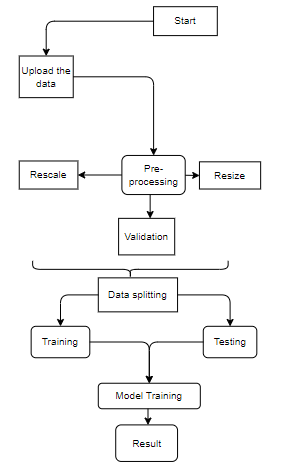
Block Diagram
Specifications
H/W CONFIGURATION:
Processor - I3/Intel Processor
Hard Disk - 160GB
Key Board - Standard Windows Keyboard
Mouse - Two or Three Button Mouse
Monitor - SVGA
RAM - 8GB
S/W CONFIGURATION:
Operating System : Windows 7/8/10
Server side Script : HTML, CSS, Bootstrap & JS
Programming Language : Python
Libraries : Flask, Pandas, Mysql.connector, Os, Smtplib, Numpy
IDE/Workbench : PyCharm
Technology : Python 3.6+
Server Deployment : Xampp Server


 Paper Publishing

Request Call Back
Would you like to receive a free callback now?
Choose the best time for callback:
Leave your message and we will contact you as soon as possible

6-2-85/B, Old Maternity Hospital Road, Thyagaraja Nagar, Tirupati, Andhra Pradesh – 517501
+91 9030333433
+91 9393939065
0877-2261612

Disclaimer - Takeoff Edu Group Projects are not associated or affiliated with IEEE in any way. The IEEE Projects mentioned here are mentioned in the context of student projects, whose ideas are derived from IEEE publications, not projects of or by IEEE.

