LightET-FusionNet as a Lightweight Deep Ensemble Model for Scalable Maize Disease Classification
Objective
The main objective of this project is to develop an advanced and accurate maize leaf disease classification system using deep learning techniques. The project integrates Adaptive Multi-Scale Dynamic Receptive Field Network (AM-DRFNet) and Dual Dynamic Attention Mechanism (DDAM) to effectively detect lesions of varying sizes and patterns in maize leaves. It aims to improve feature extraction, enhance classification accuracy, and provide better localization of disease regions. The system is implemented as a web-based application that supports image upload, disease prediction, and history tracking. Additionally, the project focuses on interpretability, scalability, and demonstrating the effectiveness of adaptive attention-based deep learning models.
Abstract
Accurate detection and classification of maize leaf diseases is essential for maintaining crop health and improving yield outcomes. Traditional convolutional neural networks struggle to identify lesions of varying sizes and shapes, often missing small disease spots or misclassifying large spread lesions. This project proposes an advanced hybrid approach combining Adaptive Multi-Scale Dynamic Receptive Field Network (AM-DRFNet) and Dual Dynamic Attention Mechanism (DDAM) to enhance disease classification performance. AM-DRFNet employs multi-dilated convolutions with a spatial gating network to provide pixel-wise adaptive receptive fields, effectively capturing both small and large lesion patterns. DDAM further refines feature representation through sequential channel and spatial attention modules, focusing on the most discriminative features and highlighting lesion regions. The system is implemented as a web-based application using HTML, CSS, JavaScript, and Python Flask, offering modules for user registration, login, disease classification, and history tracking. The dataset employed consists of maize leaf images collected from multiple disease categories, including blight, common rust, gray leaf spot, and healthy leaves. The models are trained and evaluated using performance metrics such as accuracy, precision, recall, and F1-score, demonstrating superior performance compared to baseline CNN models. This research contributes a scalable and interpretable framework for multi-class leaf disease classification, addressing challenges of variable lesion sizes and improving feature localization for enhanced model accuracy.
Keywords: Maize leaf disease, AM-DRFNet, dual attention, pixel-wise receptive field, multi-scale lesions, feature refinement, channel attention, spatial attention, leaf classification, deep learning.
NOTE: Without the concern of our team, please don't submit to the college. This Abstract varies based on student requirements.
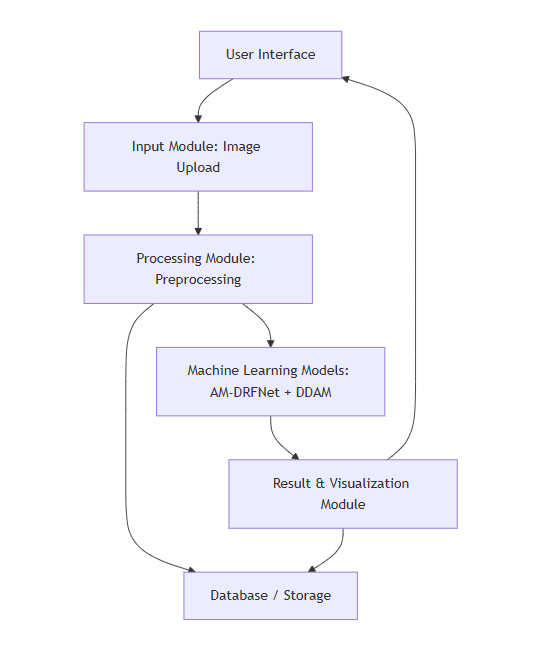
Block Diagram
Specifications
4.3 Hardware Requirements
Processor - I3/Intel Processor
Hard Disk - 160GB
Key Board - Standard Windows Keyboard
Mouse - Two or Three Button Mouse
Monitor - SVGA
RAM - 8GB
4.4 Software Requirements
Operating System : Windows 7/8/10
Programming Language : Python
Libraries : Pandas, Numpy, scikit-learn.
IDE/Workbench : Visual Studio Code.
Framework : Flask


 Paper Publishing

Request Call Back
Would you like to receive a free callback now?
Choose the best time for callback:
Leave your message and we will contact you as soon as possible

6-2-85/B, Old Maternity Hospital Road, Thyagaraja Nagar, Tirupati, Andhra Pradesh – 517501
+91 9030333433
+91 9393939065
0877-2261612

Disclaimer - Takeoff Edu Group Projects are not associated or affiliated with IEEE in any way. The IEEE Projects mentioned here are mentioned in the context of student projects, whose ideas are derived from IEEE publications, not projects of or by IEEE.

