Iot Vehicle Parameter Monitoring System
Objective
The objective of the IoT-based vehicle parameter monitoring system is to continuously track critical vehicle metrics such as CO emission, fuel level, and engine temperature in real-time. This system aims to enhance vehicle performance, ensure efficiency, and provide early detection of potential issues for timely maintenance
Abstract
With the growing need for intelligent transportation and environmental sustainability, monitoring vehicle health in real-time has become essential. This project presents an IoT-based Vehicle Parameter Monitoring System designed to continuously track key vehicle metrics such as carbon monoxide (CO) emission levels, fuel level, and engine temperature. Using a network of sensors connected to a microcontroller, the system collects and transmits real-time data to an IoT platform for remote access and analysis. If any parameter exceeds its threshold limit, instant alerts are generated for timely maintenance and preventive actions. This solution not only enhances vehicle performance and fuel efficiency but also contributes to reducing environmental pollution and ensuring road safety through proactive diagnostics and smart monitoring.
NOTE: Without the concern of our team, please don't submit to the college. This Abstract varies based on student requirements.
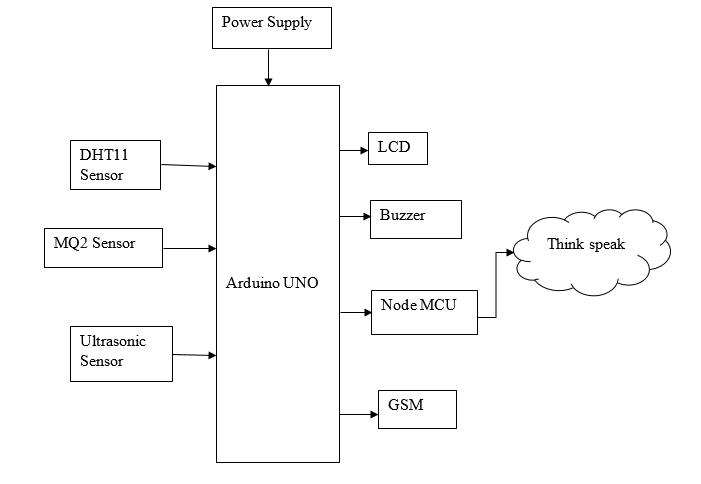
Block Diagram
Specifications
Hardware Requirements:
- Arduino UNO
- Power Supply
- DHT11 Sensor
- MQ2 Sensor
- Ultrasonic Sensor
- Buzzer
- LCD
- Node MCU
- GSM
Software Requirements:
- Embedded C
- Arduino IDE
- Thinkspeak
Learning Outcomes
- Arduino pin diagram and architecture
- How to install Arduino IDE software
- Setting up and installation procedure for Arduino
- Introduction to Arduino IDE
- Basic coding in Arduino IDE
- Basic of Embedded C language
- Basics of IoT platforms
- Working of power supply
- About Project Development Life Cycle:
- Planning and Requirement Gathering (software’s, Tools, Hardware components, etc.,)
- Schematic preparation
- Code development and debugging
- Hardware development and debugging
- Development of the Project and Output testing
- Practical exposure to:
- Hardware and software tools.
- Solution providing for real time problems.
- Working with team/ individual.
- Work on Creative ideas.
- Project development Skills
- Problem analysing skills
- Problem solving skills
- Creativity and imaginary skills
- Programming skills
- Deployment
- Testing skills
- Debugging skills
- Project presentation skills
- Thesis writing skills


 Paper Publishing

Request Call Back
Would you like to receive a free callback now?
Choose the best time for callback:
Leave your message and we will contact you as soon as possible

6-2-85/B, Old Maternity Hospital Road, Thyagaraja Nagar, Tirupati, Andhra Pradesh – 517501
+91 9030333433
+91 9393939065
0877-2261612

Disclaimer - Takeoff Edu Group Projects are not associated or affiliated with IEEE in any way. The IEEE Projects mentioned here are mentioned in the context of student projects, whose ideas are derived from IEEE publications, not projects of or by IEEE.

