IoT-Enhanced Smart Parking Management With IncepDenseMobileNet for Improved Classification
Objective
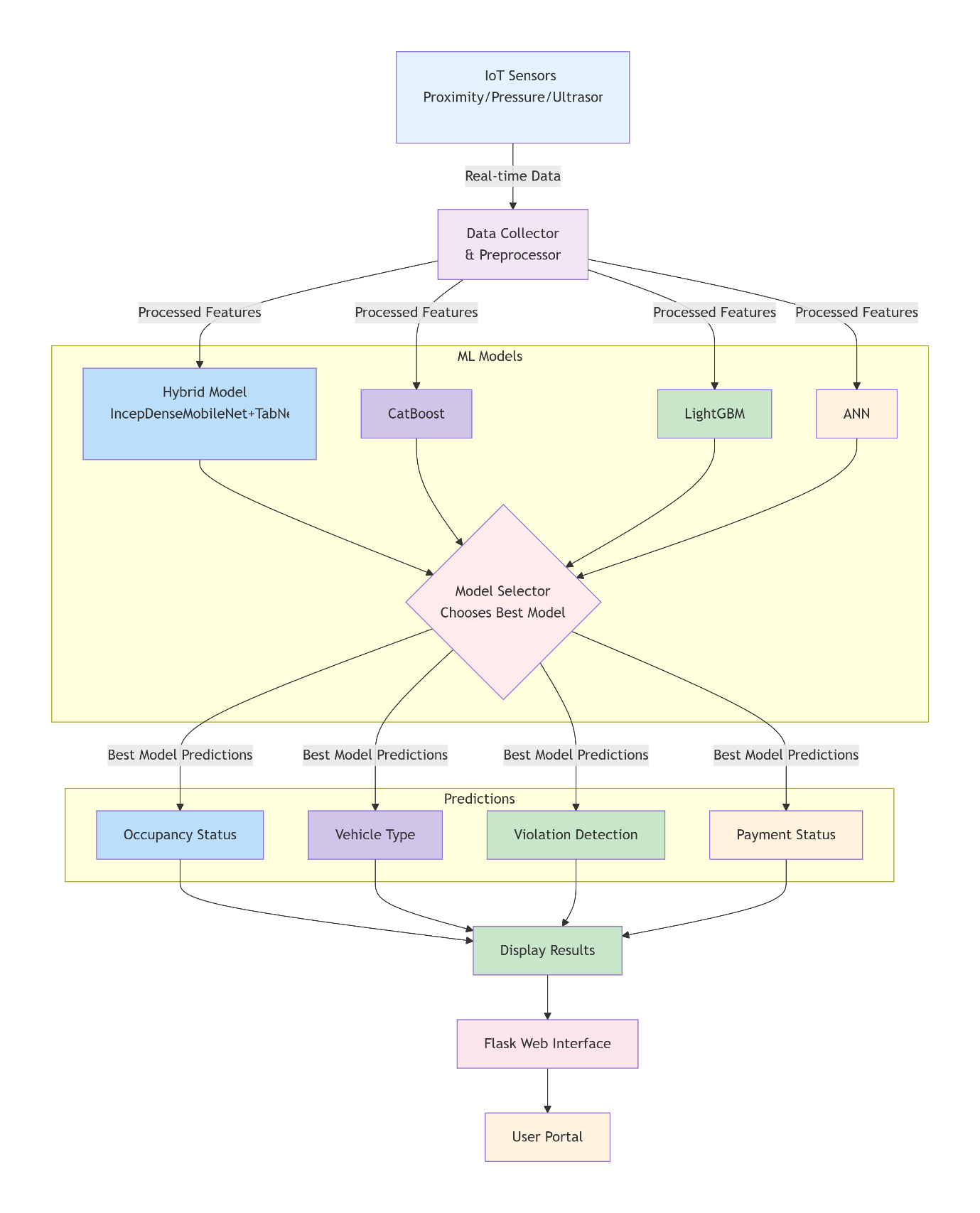
The main objective of this project is to develop an IoT-enhanced smart parking management system that leverages machine learning algorithms to classify and manage parking spaces efficiently. The system aims to classify parking space attributes, including occupancy status, vehicle types, parking violations, and payment statuses, by analyzing data from parking sensors and environmental conditions. By implementing advanced models such as IncepDenseMobileNetTabnet, CatBoost, LightGBM, and ANN, the system seeks to provide accurate classifications, ensuring optimal utilization of parking spaces. Additionally, the project strives to create an intuitive and user-friendly interface using Flask for backend development and HTML, CSS, and JavaScript for the frontend, facilitating seamless interaction for both users and administrators. The system's performance will be evaluated based on accuracy, response time, and user satisfaction to ensure it meets the desired objectives. Furthermore, the project sets the foundation for future enhancements, including mobile app integration and expanding the dataset to include more diverse data sources for improved parking management and decision-making.
Abstract
This project focuses on optimizing parking management systems through the use of machine learning techniques. The system classifies various parking attributes, such as the occupancy status of parking spaces, vehicle types, parking violations, and payment statuses, using data collected from parking sensors and environmental conditions. The project integrates an enhanced hybrid model combining IncepDenseMobileNet and TabNet for advanced data processing and feature extraction. Additionally, CatBoost, LightGBM, and Artificial Neural Networks (ANN) are separately trained to classify parking space occupancy, vehicle types, parking violations, and payment statuses accurately. These models are trained on a diverse dataset that includes sensor readings, parking spot details, user information, and violation data. The goal is to optimize parking space utilization, improve efficiency in parking management, and provide efficient monitoring for both users and administrators. The system, developed using Flask, features a web platform that allows users to interact seamlessly with the system, providing insights into parking space classifications, violations, and payment statuses.
Keywords: IoT, Smart Parking, Machine Learning, Hybrid Model, IncepDenseMobileNet, TabNet, CatBoost, LightGBM, ANN, Parking Management, Flask, Violation.
NOTE: Without the concern of our team, please don't submit to the college. This Abstract varies based on student requirements.
Block Diagram
Specifications
HARDWARE REQUIREMENTS
• Processor - I5/Intel Processor
• RAM - 8GB (min)
• Hard Disk - 160 GB
• Key Board - Standard Windows Keyboard
• Mouse - Two or Three Button Mouse
• Monitor - Any
SOFTWARE REQUIREMENS
• Operating System : Windows 7/8/10
• Server side Script : HTML, CSS, Bootstrap & JS
• Programming Language : Python
• Libraries : Flask, Pandas, Mysql.connector, Os, Numpy,
Scikit-learn.
• IDE/Workbench : VS-Code
• Technology : Python 3.10+
• Server Deployment : Xampp Server
• Database : MySQL

Demo Video


Request for Video
 Paper Publishing
Request Call Back
Would you like to receive a free callback now?
Choose the best time for callback:
Leave your message and we will contact you as soon as possible

6-2-85/B, Old Maternity Hospital Road, Thyagaraja Nagar, Tirupati, Andhra Pradesh – 517501
+91 9030333433
+91 9393939065
0877-2261612

Disclaimer - Takeoff Edu Group Projects are not associated or affiliated with IEEE in any way. The IEEE Projects mentioned here are mentioned in the context of student projects, whose ideas are derived from IEEE publications, not projects of or by IEEE.

