IoT-Enabled Smart E-Healthcare System with Predictive Prescription Algorithm for Automatic Patient Monitoring and Treatment
Objective
This study develops an IoT-enabled smart e-healthcare system with a predictive prescription algorithm for automatic patient monitoring and treatment, aiming to improve healthcare efficiency and provide personalized care.
Abstract
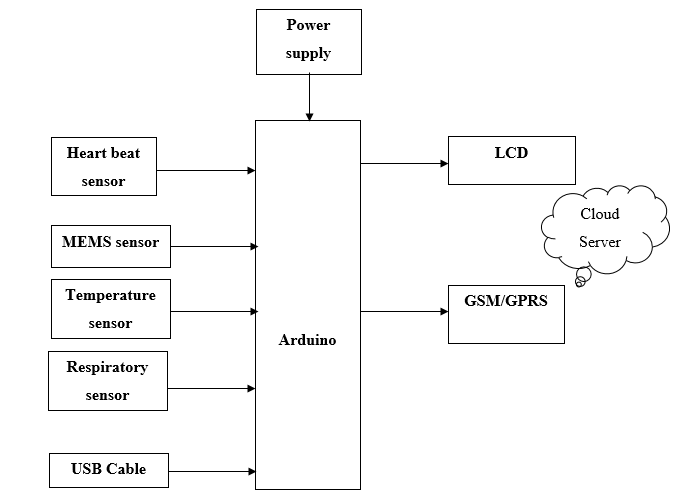
The " IoT Enabled Smart E Healthcare System with Predictive Prescription Algorithm for Automatic Patient Monitoring and Treatment" is designed to continuously track and monitor critical health parameters of patients, providing real-time data to caregivers remotely. The system integrates a range of sensors, including a heart rate sensor to monitor heartbeat, a respiratory sensor for breathing patterns, a MEMS sensor to detect abnormal walking or posture, and a Dallas temperature sensor (DS18B20) to measure body temperature. Uses Machine learning random forest algorithm for sensor data processing to give predictive alerts.With the support of GPS and GSM modules, the system enables location tracking and sends health alerts via SMS in case of abnormal conditions. An Arduino UNO serves as the central controller, processing sensor data and displaying real-time information on an LCD. The system is powered by a 5V power supply and 12V adapters, ensuring consistent operation. By leveraging IoT technologies, this system enhances patient care through continuous remote monitoring, reducing the need for in-person supervision while allowing timely intervention during medical emergencies.
NOTE: Without the concern of our team, please don't submit to the college. This Abstract varies based on student requirements.
Block Diagram
Specifications
- - Heartbeat Sensor
- - Respiratory Sensor
- - MEMS Sensor
- - Dallas Temp Sensor
- - GPS
- - GSM
- - LCD
- - 5V Power Supply
- - 12V 1A Adapter
- - Arduino UNO - Heartbeat Sensor
- - Respiratory Sensor
- - MEMS Sensor
- - Dallas Temp Sensor
- - GPS
- - GSM
- - LCD
- - 5V Power Supply
- - 12V 1A Adapter
- - Arduino UNO
Learning Outcomes
- Understanding the pin diagram and architecture of Arduino UNO.
- Installing and setting up the Arduino IDE.
- Configuring and connecting Arduino UNO with sensors and modules.
- Basic coding and programming with Arduino UNO.
- Working with health monitoring sensors like heart rate, respiratory, MEMS, and temperature sensors.
- Interfacing GPS and GSM modules with Arduino.
- Using LCDs to display real-time health data.
- Understanding the power requirements for Arduino.
- Introduction to using machine learning for predictive alerts in IoT systems.


 Paper Publishing

Request Call Back
Would you like to receive a free callback now?
Choose the best time for callback:
Leave your message and we will contact you as soon as possible

6-2-85/B, Old Maternity Hospital Road, Thyagaraja Nagar, Tirupati, Andhra Pradesh – 517501
+91 9030333433
+91 9393939065
0877-2261612

Disclaimer - Takeoff Edu Group Projects are not associated or affiliated with IEEE in any way. The IEEE Projects mentioned here are mentioned in the context of student projects, whose ideas are derived from IEEE publications, not projects of or by IEEE.

