IoT BotScan Ultra-Lightweight AI Defense Against Botnet Threats.
Objective
The objective of IoT?BotScan is to develop a lightweight, AI-driven system that accurately detects and classifies IoT botnet traffic using machine learning and deep learning algorithms. It aims to enhance IoT network security by providing efficient, reliable, and real-time threat detection with minimal computational overhead.
Abstract
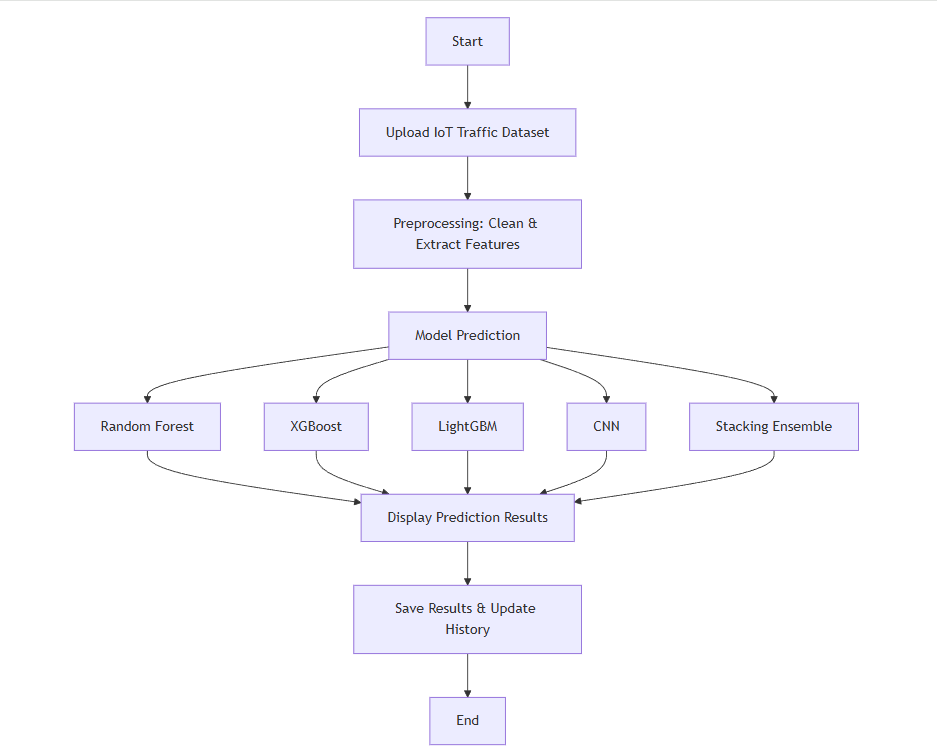
The rapid growth of IoT environments has increased exposure to botnet-based attacks that disrupt system behavior and consume network resources. Traditional detection methods often require heavy computation and complex deployment, making them unsuitable for lightweight environments. This project, titled “IoT BotScan: Ultra-Lightweight AI Defense Against Botnet Threats”, presents an efficient detection framework using machine learning and deep learning techniques. The system analyzes network traffic patterns from the N-BaIoT dataset to identify malicious activities. Multiple algorithms such as Random Forest, XGBoost, LightGBM, Convolutional Neural Networks, and a stacking-based ensemble model are implemented to improve detection accuracy and stability. The proposed framework is designed using a Flask-based web application that provides secure access through authentication modules and a prediction interface. Feature extraction and model training are optimized to reduce complexity while maintaining reliable performance. The stacking approach combines the strengths of individual models to enhance classification capability. This project demonstrates that lightweight AI models can effectively detect botnet behavior without excessive processing overhead. The system aims to support secure IoT communication by providing a scalable and efficient defense mechanism suitable for research and academic analysis.
Keywords: IoT Security, Botnet Detection, Machine Learning, Deep Learning, Random Forest, XGBoost, LightGBM, CNN, Stacking Model, Flask.
NOTE: Without the concern of our team, please don't submit to the college. This Abstract varies based on student requirements.
Block Diagram
Specifications
Hardware Requirements
Processor - I3/Intel Processor
Hard Disk - 160GB
Key Board - Standard Windows Keyboard
Mouse - Two or Three Button Mouse
Monitor - SVGA
RAM - 8GB
Software Requirements
Operating System : Windows 7/8/10
Programming Language : Python
Libraries : Pandas, Numpy, scikit-learn.
IDE/Workbench : Visual Studio Code.
Framework : Flask


 Paper Publishing

Request Call Back
Would you like to receive a free callback now?
Choose the best time for callback:
Leave your message and we will contact you as soon as possible

6-2-85/B, Old Maternity Hospital Road, Thyagaraja Nagar, Tirupati, Andhra Pradesh – 517501
+91 9030333433
+91 9393939065
0877-2261612

Disclaimer - Takeoff Edu Group Projects are not associated or affiliated with IEEE in any way. The IEEE Projects mentioned here are mentioned in the context of student projects, whose ideas are derived from IEEE publications, not projects of or by IEEE.

