IOT Based Smart Museum using Bluetooth Low Energy
Objective
The main objective of this project is to share knowledge about historical arts to visitors by using BLE technology
Abstract
In today’s world everything is extended to be smart and smarter through the development of technologies. To match these smart things, our environment needs to become smarter because environment speaks to people and people speaks to the world at a point through a technology that we called as IoT.
Nowadays, People are more interested to follow our ancient culture and the future generations also have to follow our cultural heritage. Museum is one of the places where objects of historical, scientific, artistic, or cultural interest are stored and exhibited. To get the attention of visitor I propose the smart museum using IoT device. A smart museum based on IOT relies on Bluetooth device that acts as guides of museum.
The whole system and localization information is obtained by a Bluetooth low energy (BLE) which is installed in the museum. Moreover, the system interacts with the Cloud to store multimedia contents produced by the user. Finally, everyone can easily access the arts profile and history through smart device by using mobile application.
Keywords: ESP32, LED, Buzzer, Power supply
NOTE: Without the concern of our team, please don't submit to the college. This Abstract varies based on student requirements.
Block Diagram
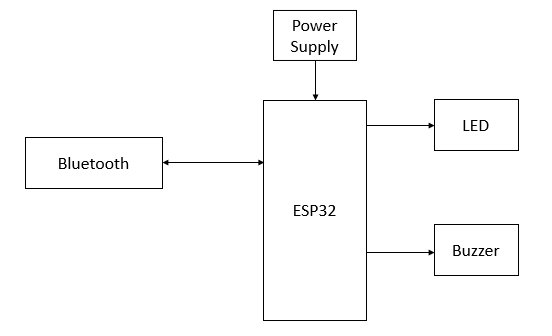
Specifications
- ESP32
- Bluetooth
- LED
- Resistor
- Buzzer
- Power supply
- Arduino IDE
- BLE scanner app
Learning Outcomes
- ESP32 pin diagram and architecture
- How to install Arduino IDE software
- Setting up and installation procedure for Arduino
- Introduction to Arduino IDE
- Basic coding in Arduino IDE
- Working of LED
- Interface LED with ESP32?
- Working of Buzzer
- Interface Buzzer with ESP32?
- Communication between an android mobile and ESP32 module using BLE technology
- Working of power supply
- About Project Development Life Cycle:
- Planning and Requirement Gathering( software’s, Tools, Hardware components, etc.,)
- Schematic preparation
- Code development and debugging
- Hardware development and debugging
- Development of the Project and Output testing
- Practical exposure to:
- Hardware and software tools.
- Solution providing for real time problems.
- Working with team/ individual.
- Work on Creative ideas.
- Project development Skills
- Problem analyzing skills
- Problem solving skills
- Creativity and imaginary skills
- Programming skills
- Deployment
- Testing skills
- Debugging skills
- Project presentation skills
- Thesis writing skills


 Paper Publishing

Request Call Back
Would you like to receive a free callback now?
Choose the best time for callback:
Leave your message and we will contact you as soon as possible

6-2-85/B, Old Maternity Hospital Road, Thyagaraja Nagar, Tirupati, Andhra Pradesh – 517501
+91 9030333433
+91 9393939065
0877-2261612

Disclaimer - Takeoff Edu Group Projects are not associated or affiliated with IEEE in any way. The IEEE Projects mentioned here are mentioned in the context of student projects, whose ideas are derived from IEEE publications, not projects of or by IEEE.

