IoT Based Organic Farming by Using Aquaponics Method
Also Available Domains IOT|Raspberry pi|Arduino|ARM7
Objective
The main objective of this system is to develop an Internet of Things based aquaponics monitoring system which measures and displays parameters like pH level, water level, humidity, temperature, through an IOT platform.
Abstract
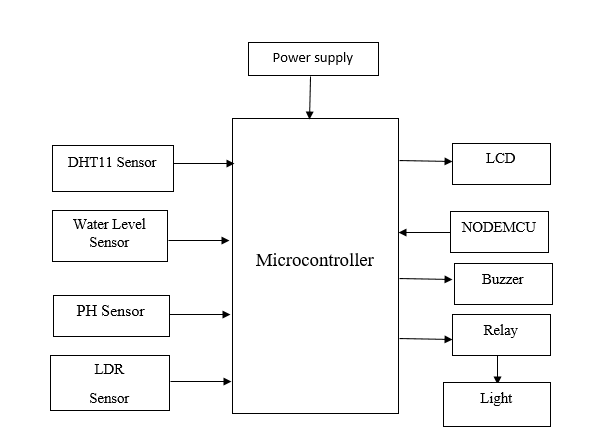
As agriculture undergoes a paradigm shift towards sustainability and efficiency, the integration of the Internet of Things (IoT) technology has enabled innovative approaches like aquaponics to revolutionize organic farming practices. This presents a pioneering "IoT-Based Organic Farming by Using Aquaponics Method" that leverages a sophisticated system comprising microcontroller, DHT11 sensor for temperature and humidity monitoring, water level sensor, PH sensor, LCD display, NODEMCU, relay, and lighting by LDR sensor.
At its core, a microcontroller serves as the central hub, orchestrating the coordination of various sensors and actuators. DHT11 sensors provide data on temperature and humidity, enabling climate control within the aquaponics system. Water level sensors and pH sensors monitor vital parameters of the aquatic environment, ensuring optimal conditions for both fish and plants. An LCD display offers a user-friendly interface for data visualization .Buzzer is used for alert purpose. NODEMCU provides integration allows remote monitoring and analysis, facilitating informed decision-making. The relay system and artificial lighting enable automated control of lighting conditions by LDR sensor, promoting plant growth. This IoT-based approach promises to optimize organic farming, enhance resource utilization, and foster sustainable agricultural practices, presenting a compelling solution to meet the demands of modern agriculture.
Keywords: Aquaponics, Aquaculture, Microcontroller, Internet of things, NODEMCU.
NOTE: Without the concern of our team, please don't submit to the college. This Abstract varies based on student requirements.
Block Diagram
Specifications
Hardware components:
- PIC microcontroller
- DHT11 Sensor
- Water Level Sensor
- PH sensor
- LDR Sensor
- LCD
- NODEMCU
- Relay
- Light
- Buzzer
Software Components:
- MP lab
- Embedded C
Learning Outcomes
- PIC controller diagram and architecture
- How to install MP lab
- Setting up and installation procedure for MP lab
- Introduction to PIC controller
- Basic coding in MP lab
- Working of power supply
- About Project Development Life Cycle:
- Planning and Requirement Gathering (software’s, Tools, Hardware components, etc.,)
- Schematic preparation
- Code development and debugging
- Hardware development and debugging
- Development of the Project and Output testing
- Practical exposure to:
- Hardware and software tools.
- Solution providing for real time problems.
- Working with team/ individual.
- Work on Creative ideas.
- Project development Skills
- Problem analyzing skills
- Problem solving skills
- Creativity and imaginary skills
- Programming skills
- Deployment
- Testing skills
- Debugging skills
- Project presentation skills


 Paper Publishing

Request Call Back
Would you like to receive a free callback now?
Choose the best time for callback:
Leave your message and we will contact you as soon as possible

6-2-85/B, Old Maternity Hospital Road, Thyagaraja Nagar, Tirupati, Andhra Pradesh – 517501
+91 9030333433
+91 9393939065
0877-2261612

Disclaimer - Takeoff Edu Group Projects are not associated or affiliated with IEEE in any way. The IEEE Projects mentioned here are mentioned in the context of student projects, whose ideas are derived from IEEE publications, not projects of or by IEEE.

