IoT-Based Non-Intrusive Automated Driver Drowsiness Monitoring Framework for Logistics and Public Transport Applications to Enhance Road Safety
Objective
The main objective of this project is to design and implement an IoT-based automated driver drowsiness monitoring framework for logistics and public transport applications, aimed at enhancing road safety through non-intrusive monitoring and timely alerts
Abstract
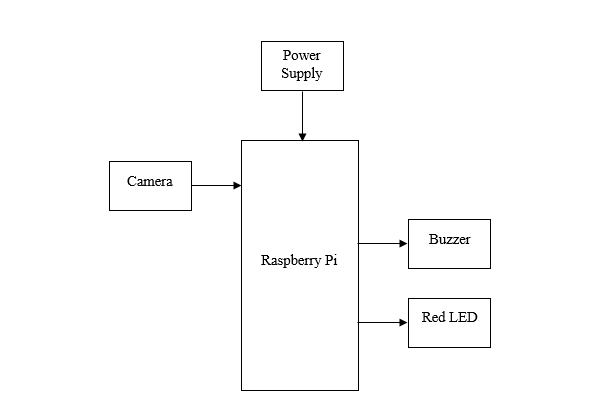
This project presents an interface design for a driver fatigue detection system using a Raspberry Pi, camera module, red light, and buzzer. This project utilizes a Haar cascade classifier to detect closed eyes and yawning patterns of the driver, aiming to alert them and prevent potential accidents caused by drowsiness. The interface design involves the integration of hardware components with software classifiers to create an effective and user-friendly system. The Raspberry Pi acts as the central processing unit, responsible for capturing video feed from the camera module and processing it. The Haar cascade classifier is employed to detect specific facial features associated with closed eyes and yawning.
To provide immediate feedback to the driver, the system incorporates a red light and a buzzer. When the controller detects closed eyes or yawning, the red light is triggered, providing a visual warning to the driver. Simultaneously, the buzzer emits an audible alarm to further alert the driver and ensure their attention is regained. The system's ability to detect closed eyes and yawning patterns facilitates timely intervention, preventing accidents and potentially saving lives.
Keywords: Raspberry Pi, Camera Interface, Driver Fatigue Detection, Haar Cascade Classifier, Closed Eyes Detection, Yawning Detection, Monitoring.
NOTE: Without the concern of our team, please don't submit to the college. This Abstract varies based on student requirements.
Block Diagram
Specifications
Hardware Requirements:
- Raspberry pi
- Web camera
- Buzzer
- LED
Software Requirements:
- Raspberry pi OS
- Python
Learning Outcomes
- Raspberry pi pin diagram and architecture
- How to install Rasbian software
- Setting up and installation procedure for Raspberry Pi
- Introduction to python
- Basic coding in python
- Working of LCD
- Interface LCD with Raspberry Pi
- Working of power supply
- About Project Development Life Cycle
- Planning and Requirement Gathering (software’s, Tools, Hardware components, etc.,)
- Schematic preparation
- Code development and debugging
- Hardware development and debugging
- Development of the Project and Output testing
- Practical exposure to
- Hardware and software tools.
- Solution providing for real time problems.
- Working with team individual.
- Work on Creative ideas.
- Project development Skills
- Problem analyzing skills
- Problem solving skills
- Creativity and imaginary skills
- Programming skills
- Deployment
- Testing skills
- Debugging skills
- Project presentation skills


 Paper Publishing

Request Call Back
Would you like to receive a free callback now?
Choose the best time for callback:
Leave your message and we will contact you as soon as possible

6-2-85/B, Old Maternity Hospital Road, Thyagaraja Nagar, Tirupati, Andhra Pradesh – 517501
+91 9030333433
+91 9393939065
0877-2261612

Disclaimer - Takeoff Edu Group Projects are not associated or affiliated with IEEE in any way. The IEEE Projects mentioned here are mentioned in the context of student projects, whose ideas are derived from IEEE publications, not projects of or by IEEE.

