IoT Based Automatic Breaking Control System for EV Vehicle and Monitoring System
Objective
The intersection of IoT and electric vehicles, where an automatic braking control system ensures safety while a comprehensive monitoring system provides insights for efficient and sustainable driving experiences.
Abstract
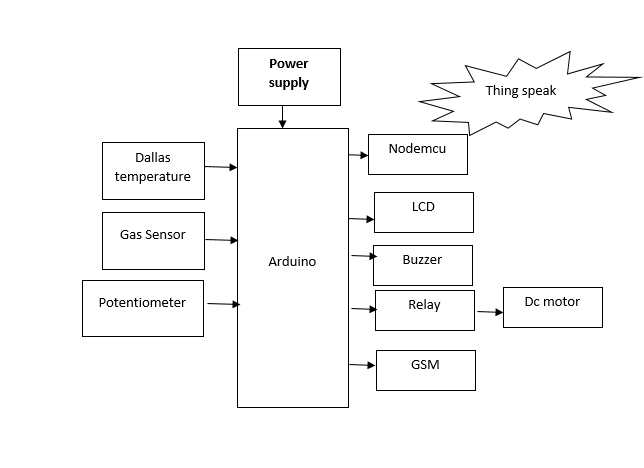
This project presents an IoT-based Automatic Braking Control and Monitoring System for Electric Vehicles (EVs), aimed at enhancing safety through real-time environmental sensing and system response. The system integrates sensors including a Dallas temperature sensor, gas sensor, and a potentiometer to monitor temperature, gas levels, and voltage variations. If the temperature or gas concentration exceeds predefined thresholds, the DC motor controlling the vehicle is automatically halted, a buzzer is activated, and an alert is sent via a GSM module. Additionally, the system uses four LEDs to indicate voltage levels—two LEDs turn off as voltage drops, and all LEDs switch off if the voltage falls below a critical point, triggering the buzzer and GSM alert. The potentiometer allows manual voltage variation for testing and demonstration. All sensor data is uploaded in real-time to the Thing Speak IoT platform using a NodeMCU module, allowing remote monitoring and data logging for further analysis and system optimization.
NOTE: Without the concern of our team, please don't submit to the college. This Abstract varies based on student requirements.
Block Diagram
Specifications
Hardware requirements:
- Arduino
- LCD
- Buzzer
- Dallas temperature
- Gas Sensor
- Potentiometer
- Relay
- DC motor
- Power supply
Software requirements:
- Arduino IDE
- Embedded C
Learning Outcomes
- Arduino Pin diagram and Architecture
- How to install Arduino IDE Software
- Setting up and Installation procedures for Arduino IDE
- Introduction to Arduino IDE
- Commands in Embedded C
- How to install Libraries?
- Basic coding in Embedded C
- Working of Gas Sensor
- Working of Dallas temperature
- How to interface Relay with Arduino
- How to interface Buzzer with Arduino?
- Working of LCD
- How to interface LCD with Arduino?
- About Project Development Life Cycle:
- Planning and Requirement Gathering (software’s, Tools, Hardware components, etc.,)
- Schematic preparation
- Code development and debugging
- Hardware development and debugging
- Development of the Project and Output testing
- Practical exposure to:
- Hardware and software tools.
- Solution providing for real time problems.
- Working with team/ individual.
- Work on Creative ideas.
- Project development Skills
- Problem analyzing skills
- Problem solving skills
- Creativity and imaginary skills
- Programming skills
- Deployment
- Testing skills
- Debugging skills
- Project presentation skills
- Thesis writing skills


 Paper Publishing

Request Call Back
Would you like to receive a free callback now?
Choose the best time for callback:
Leave your message and we will contact you as soon as possible

6-2-85/B, Old Maternity Hospital Road, Thyagaraja Nagar, Tirupati, Andhra Pradesh – 517501
+91 9030333433
+91 9393939065
0877-2261612

Disclaimer - Takeoff Edu Group Projects are not associated or affiliated with IEEE in any way. The IEEE Projects mentioned here are mentioned in the context of student projects, whose ideas are derived from IEEE publications, not projects of or by IEEE.

