IOT based Anti-theft Flooring System using Raspberry Pi
Objective
The objective of this project is to develop an IoT-based anti-theft floor mat system using Raspberry Pi that monitors floor movements and provides real-time alerts and surveillance. The system aims to enhance home security by enabling remote monitoring, capturing intruder activity via sensors and camera, and ensuring data privacy, scalability, and rapid response to unauthorized access.
Abstract
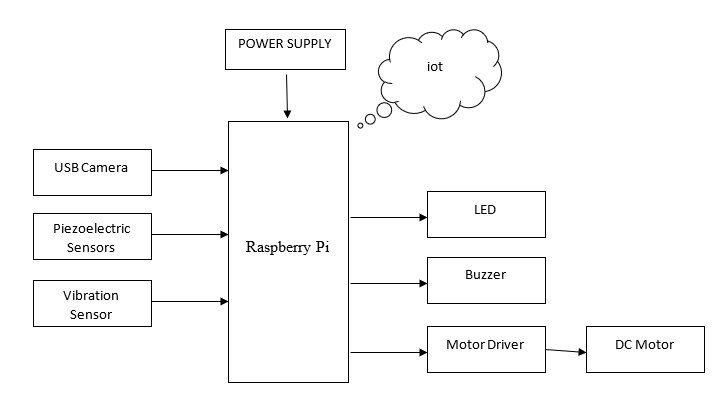
IoT-Based Anti-Theft Flooring System Using Raspberry Pi is an intelligent security system designed to enhance access control and intrusion detection in restricted areas. The system utilizes Raspberry Pi as the main controller along with a USB camera for face detection and recognition. Piezoelectric sensors embedded beneath the flooring generate electrical energy from footsteps while also contributing to occupancy monitoring. Vibration sensors continuously detect floor movements and unauthorized activities. When a person steps onto the flooring, the USB camera captures the individual's face and performs facial recognition using a trained deep learning model. If the person is recognized as an authorized user, a motor driver activates a DC motor to indicate access permission. If an unauthorized individual is detected, the system immediately activates a buzzer and LED indicators while generating an alert. IoT technology enables remote monitoring and event logging through cloud platforms. Python is used for facial recognition, sensor data processing, and IoT communication. And all the data will upload to cloud platform.
NOTE: Without the concern of our team, please don't submit to the college. This Abstract varies based on student requirements.
Block Diagram
Specifications
Hardware components:
- Raspberry Pi
- USB Camera
- Piezoelectric Sensors (6)
- Vibration Sensor
- Motor Driver Module
- DC Motor
- Buzzer
- LED Indicators
- Power Supply
- 12V Adapter
- Connectors – 30
Software components:
- Raspbian OS
- Python
Learning Outcomes
- Understand Raspberry Pi architecture and GPIO configuration
- Learn how to install and configure Raspbian OS and required Python libraries
- Interface analog sensors with Raspberry Pi using MCP3008 ADC
- Implement image classification using Artificial Neural Networks
- Develop real-time skin analysis using USB camera input
- Build automated health screening systems with display and alert features
- Integrate temperature and heartbeat monitoring in diagnostic systems
- Analyze and interpret classification output for healthcare applications
- About Project Development Life Cycle:
- Planning and Requirement Gathering (software’s, Tools, Hardware components, etc.,)
- Schematic preparation
- Code development and debugging
- Hardware development and debugging
- Development of the Project and Output testing
- Practical exposure to:
- Hardware and software tools.
- Solution providing for real time problems.
- Working with team/ individual.
- Work on Creative ideas.
- Project development Skills:
- Problem analyzing skills
- Problem solving skills
- Creativity and imaginary skills
- Programming skills
- Deployment
- Testing skills
- Debugging skills
- Project presentation skills


 Paper Publishing

Request Call Back
Would you like to receive a free callback now?
Choose the best time for callback:
Leave your message and we will contact you as soon as possible

6-2-85/B, Old Maternity Hospital Road, Thyagaraja Nagar, Tirupati, Andhra Pradesh – 517501
+91 9030333433
+91 9393939065
0877-2261612

Disclaimer - Takeoff Edu Group Projects are not associated or affiliated with IEEE in any way. The IEEE Projects mentioned here are mentioned in the context of student projects, whose ideas are derived from IEEE publications, not projects of or by IEEE.

