IoT and Machine Learning-Based Smart Soil Irrigation Farming Systems
Also Available Domains Machine Learning
Objective
This project explores integrating IoT and machine learning for smart soil irrigation, optimizing water usage, enhancing crop yield, and improving sustainability in farming through real-time monitoring and data-driven decision-making.
Abstract
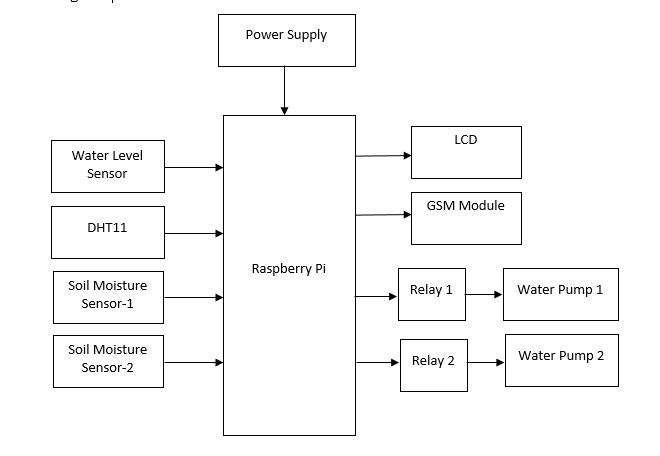
Interfacing a Raspberry Pi with various sensors and integrating their data into a machine learning model to control pumps and provide feedback through an LCD and GSM module exemplifies an advanced application of the Internet of Things (IoT) in smart agriculture. This system uses a DHT11 sensor for temperature and humidity, a water level sensor, two soil moisture sensors, pumps, an LCD for visual feedback, and a GSM module for critical condition alerts. Each component is vital for monitoring and maintaining optimal plant growth conditions. The DHT11 sensor measures ambient temperature and humidity using a capacitive humidity sensor and a thermistor, providing a digital signal crucial for understanding environmental conditions affecting soil moisture and plant health. The water level sensor ensures there is adequate water. Two soil moisture sensors measure the soil's moisture content at different locations. The data from these sensors is essential for determining soil moisture levels, directly influencing the irrigation schedule. This moisture data is fed into a machine learning model that analyses it to predict optimal irrigation times and amounts.
The integration of a machine learning model enhances the system's intelligence. Trained on historical data, this model predicts soil moisture levels based on current and past readings, weather conditions, and other environmental factors. By analysing data from the soil moisture sensors, the model determines when the soil needs more water and activates the pumps accordingly. This predictive capability ensures plants receive the right amount of water, avoiding both under-watering and over-watering, which can harm plant health. An LCD provides visual feedback, in addition to visual feedback, the system is equipped with a GSM module to send text messages in critical conditions.
NOTE: Without the concern of our team, please don't submit to the college. This Abstract varies based on student requirements.
Block Diagram
Specifications
Hardware Requirements:
- Raspberry Pi
- DHT11
- Water Level Sensor
- LCD
- GSM Module
- Relay
- Water Pumping Motor
- Soil Moisture Sensor
- Power Supply
- Buzzer
- LCD
Software Requirements:
- Python IDLE
- Raspbian OS
Learning Outcomes
- Introduction to Python IDE
- Basic coding in Python IDLE
- Working of LCD
- Interface LCD with Raspberry Pi
- Working of power supply
- About Project Development Life Cycle:
- Planning and Requirement Gathering (software’s, Tools, Hardware components, etc.,)
- Schematic preparation
- Code development and debugging
- Hardware development and debugging
- Development of the Project and Output testing
- Practical exposure to:
- Hardware and software tools.
- Solution providing for real time problems.
- Working with team/ individual.
- Work on Creative ideas.
- Project development Skills
- Problem analyzing skills
- Problem solving skills
- Creativity and imaginary skills
- Programming skills
- Deployment
- Testing skills
- Debugging skills
- Project presentation skills


 Paper Publishing

Request Call Back
Would you like to receive a free callback now?
Choose the best time for callback:
Leave your message and we will contact you as soon as possible

6-2-85/B, Old Maternity Hospital Road, Thyagaraja Nagar, Tirupati, Andhra Pradesh – 517501
+91 9030333433
+91 9393939065
0877-2261612

Disclaimer - Takeoff Edu Group Projects are not associated or affiliated with IEEE in any way. The IEEE Projects mentioned here are mentioned in the context of student projects, whose ideas are derived from IEEE publications, not projects of or by IEEE.

