Intrusion detection system in Healthcare ecosystem using customized neural network
Objective
The objective of this project is to design and implement an intelligent intrusion detection system tailored for the healthcare ecosystem using a customized neural network architecture. The system aims to secure sensitive medical data, IoT-enabled health devices, and patient monitoring networks from cyberattacks. By leveraging deep learning techniques, the proposed model identifies abnormal patterns and potential threats in real time, ensuring high accuracy and low false-positive rates. This proactive solution enhances data privacy, strengthens healthcare cybersecurity infrastructure, and supports seamless medical operations by detecting and mitigating intrusions before they compromise critical systems.
Abstract
The healthcare ecosystem is increasingly reliant on IoT devices for monitoring and managing patient health. However, the proliferation of connected devices introduces significant security vulnerabilities, making healthcare systems prone to cyberattacks, data breaches, and system intrusions. This project proposes an Intrusion Detection System (IDS) specifically tailored for the healthcare ecosystem, leveraging customized neural network architectures to identify and mitigate these security risks. The IDS analyzes real-time network traffic data generated by IoT devices within healthcare environments to detect anomalous behaviors indicative of cyber threats. The system uses a variety of machine learning algorithms such as Convolutional Neural Networks (CNN), XGBoost, and Random Forest to classify network traffic as either benign or malicious. With CNN's capability to capture intricate patterns in network traffic, the system ensures high accuracy in intrusion detection, even under complex attack scenarios. Additionally, the system provides actionable alerts, enabling timely response and mitigation measures to prevent potential security breaches. This project aims to enhance the security of healthcare systems by providing a robust, scalable, and intelligent intrusion detection mechanism, ensuring the integrity and confidentiality of patient data. The system is designed to be highly efficient, capable of handling the vast amounts of data generated in healthcare networks.
Keywords: Intrusion Detection, Healthcare Ecosystem, IoT Security, Neural Networks, Machine Learning, Convolutional Neural Networks (CNN), XGBoost, Random Forest, Cybersecurity, Data Protection.
NOTE: Without the concern of our team, please don't submit to the college. This Abstract varies based on student requirements.
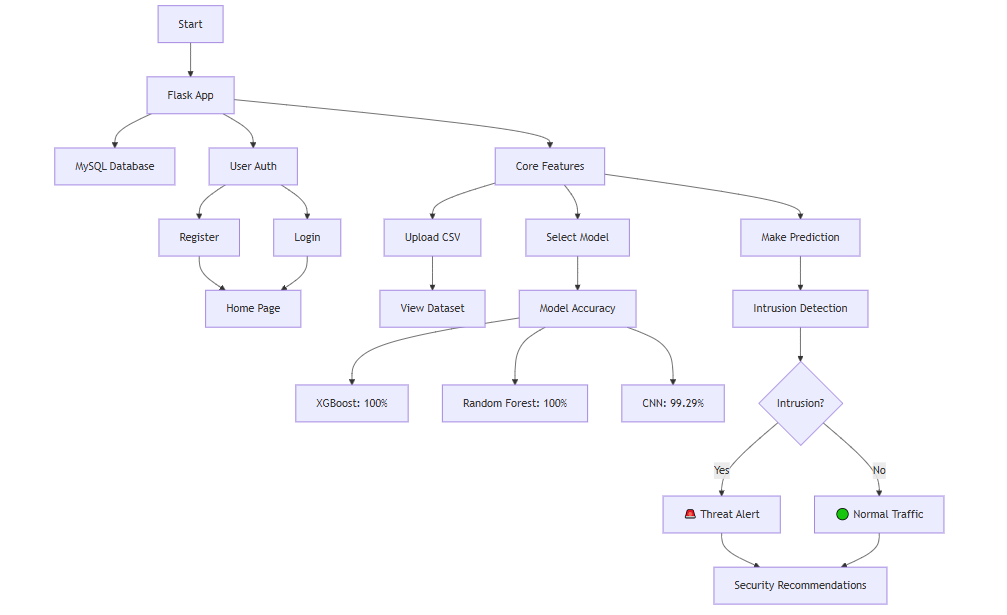
Block Diagram
Specifications
SOFTWARE REQUIREMENS
Operating System : Windows 7/8/10
Server side Script : HTML, CSS, Bootstrap & JS
Programming Language : Python
Libraries : Flask, Pandas, Torch, Keras, Sklearn, Numpy , Seaborn
IDE/Workbench : VSCODE
Server Deployment : Xampp Server
Database : MySQL
HARDWARE REQUIREMENTS
Processor - I3/Intel Processor
RAM - 8GB (min)
Hard Disk - 128 GB
Key Board - Standard Windows Keyboard
Mouse - Two or Three Button Mouse
Monitor - Any


 Paper Publishing

Request Call Back
Would you like to receive a free callback now?
Choose the best time for callback:
Leave your message and we will contact you as soon as possible

6-2-85/B, Old Maternity Hospital Road, Thyagaraja Nagar, Tirupati, Andhra Pradesh – 517501
+91 9030333433
+91 9393939065
0877-2261612

Disclaimer - Takeoff Edu Group Projects are not associated or affiliated with IEEE in any way. The IEEE Projects mentioned here are mentioned in the context of student projects, whose ideas are derived from IEEE publications, not projects of or by IEEE.

