Intrusion Detection and Prevention System IDPS Model for IIoT Environments Using Hybridized Framework
Objective
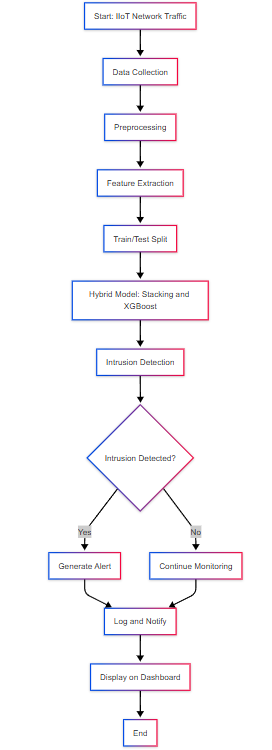
The objective of this study is to design and implement a highly accurate and scalable Intrusion Detection and Prevention System (IDPS) tailored for Industrial Internet of Things (IIoT) environments. By utilizing a hybrid machine learning approach that integrates XGBoost with a Stacking Classifier framework, the proposed system aims to enhance intrusion detection accuracy, minimize response time, and address the limitations of existing deep learning models such as CNNs, which often suffer from overfitting and poor generalization. Validated using the NSL-KDD dataset, this model demonstrates superior performance in detecting diverse attack patterns with high precision, recall, and F1-score. The ultimate goal is to provide a real-time, reliable security mechanism capable of protecting critical IIoT infrastructures from evolving cyber threats while ensuring operational continuity.
Abstract
Keywords: Intrusion Detection and Prevention System (IDPS), Industrial Internet of Things (IIoT), Hybrid Machine Learning, Stacking Classifier, XGBoost, NSL-KDD Dataset, Cyber Security, Network Intrusion Detection
NOTE: Without the concern of our team, please don't submit to the college. This Abstract varies based on student requirements.
Block Diagram
Specifications
e. software requirements
Operating System :
Windows 10/11 or Ubuntu Linux
Frontend :
HTML, CSS, Bootstrap, JavaScript
Programming Language
Python 3.8+
Libraries :
Flask, Scikit-learn, XGBoost, PyTorch, Pandas, NumPy, mysql-connector-python
IDE / Workbench :
Visual Studio Code, Jupyter Notebook
Server Deployment :
Flask Development Server / XAMPP
Database :
MySQL
f. Hardware requirements
Processor :
Intel Core i5 / i7 or AMD Ryzen
RAM :
8 GB Minimum (16 GB Recommended)
Hard Disk :
256 GB SSD or Higher
Keyboard :
Standard Windows Keyboard
Mouse :
Two or Three Button Optical Mouse
Monitor :
15” or Higher Resolution Display
GPU (Optional):
NVIDIA GPU with CUDA (for CNN training)

Demo Video


Request for Video
 Paper Publishing
Request Call Back
Would you like to receive a free callback now?
Choose the best time for callback:
Leave your message and we will contact you as soon as possible

6-2-85/B, Old Maternity Hospital Road, Thyagaraja Nagar, Tirupati, Andhra Pradesh – 517501
+91 9030333433
+91 9393939065
0877-2261612

Disclaimer - Takeoff Edu Group Projects are not associated or affiliated with IEEE in any way. The IEEE Projects mentioned here are mentioned in the context of student projects, whose ideas are derived from IEEE publications, not projects of or by IEEE.

