Intelligent Ultrasound Imaging for Enhanced Breast Cancer Diagnosis Ensemble
Objective
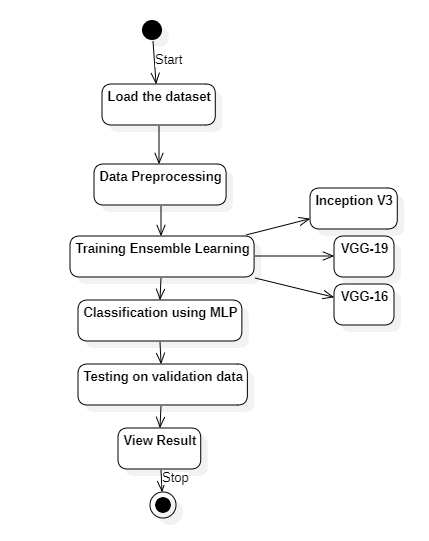
The project aims to develop an intelligent ultrasound imaging system for enhanced breast cancer diagnosis. Objectives include assembling a diverse dataset, applying preprocessing techniques like augmentation, and using transfer learning with deep learning models. It involves partitioning the dataset for robust validation, employing MLP and SVM models for classification, and fine-tuning architectures to optimize performance. The goal is to create a reliable system for early and accurate breast cancer detection, aiming to improve patient outcomes significantly.
Abstract
Breast cancer remains a critical global health concern, necessitating early detection for improved patient outcomes. This study proposes an automated system for enhanced breast cancer diagnosis through intelligent ultrasound imaging. The system begins with the assembly of a diverse ultrasound breast cancer (USBC) image dataset, encompassing normal, benign, and malignant cases. Various preprocessing techniques, including data augmentation, cropping, and resizing, are applied to standardize and augment the dataset. Transfer learning is leveraged to extract features from USBC images using established deep learning models, namely VGG-16, Inception V3, and VGG-19. Extracted features are stored for efficient data handling during model training and evaluation. The dataset is partitioned using 10-fold cross-validation, ensuring robust model validation. Two machine learning models, Multi-Layer Perceptron (MLP) and Support Vector Machines (SVM), are employed for breast cancer classification. MLP architectures with varying layer sizes and SVM models with polynomial and radial basis function kernels are fine-tuned for optimal performance. Ultimately, MLP serves as the final classifier, offering a promising approach for accurate and efficient breast cancer identification.
KEYWORDS: Breast cancer, ultrasound imaging, transfer learning, deep learning models, data augmentation, preprocessing techniques, machine learning classification, MLP architecture, SVM kernels, model validation.
NOTE: Without the concern of our team, please don't submit to the college. This Abstract varies based on student requirements.
Block Diagram
Specifications
H/W CONFIGURATION:
Processor - I3/Intel Processor
Hard Disk - 160GB
Key Board - Standard Windows Keyboard
Mouse - Two or Three Button Mouse
Monitor - SVGA
RAM - 8GB
S/W CONFIGURATION:
• Operating System : Windows 7/8/10
• Programming Language : Python
• Libraries : Pandas, Numpy, scikit-learn.
• IDE/Workbench : Visual Studio Code.

Demo Video


Request for Video
 Paper Publishing
Request Call Back
Would you like to receive a free callback now?
Choose the best time for callback:
Leave your message and we will contact you as soon as possible

6-2-85/B, Old Maternity Hospital Road, Thyagaraja Nagar, Tirupati, Andhra Pradesh – 517501
+91 9030333433
+91 9393939065
0877-2261612

Disclaimer - Takeoff Edu Group Projects are not associated or affiliated with IEEE in any way. The IEEE Projects mentioned here are mentioned in the context of student projects, whose ideas are derived from IEEE publications, not projects of or by IEEE.

