Intelligent Tree Canopy Segmentation From UAV Imagery to Support Urban and Rural Garden Design
Objective
This project introduces an end-to-end deep learning pipeline for automated tree canopy segmentation from UAV aerial imagery. Two models were developed: AerialFormer (Swin Transformer Tiny) and UNetFormer (ResNet50 with window attention). Trained on the restor/tcd dataset with BCE + Dice loss, AerialFormer achieved superior performance. Deployed via a Flask web app, users can upload images and receive instant segmentation masks, probability heatmaps, canopy overlays, and coverage statistics for urban planning and ecological monitoring.
Abstract
Accurate tree canopy mapping is fundamental for urban planning, ecological monitoring, and garden design. This project presents an end‑to‑end deep learning pipeline that automates tree canopy segmentation from UAV aerial imagery and makes it accessible through a web application. Two transformer‑enhanced segmentation models were developed and evaluated: AerialFormer (Swin Transformer Tiny encoder with CNN stem and multi‑scale decoder) and UNetFormer (ResNet50 encoder with memory‑efficient window attention in decoder blocks). Both were trained on the high‑resolution restor/tcd dataset using a combined BCE + Dice loss, AdamW optimization, and cosine annealing. For the front‑end interface, the best‑performing model (AerialFormer) is deployed within a Flask‑based web application. Users can upload UAV images and instantly receive a complete segmentation panel including predicted mask, probability heatmap, canopy‑overlay visualization, and coverage percentage. The system delivers actionable spatial insights for tree distribution assessment, land‑use decisions, and sustainable landscape design in both urban and rural environments
Keywords: Tree canopy segmentation; UAV imagery; deep learning; Swin Transformer; AerialFormer; UNetFormer; Flask web application; garden design; remote sensing.
NOTE: Without the concern of our team, please don't submit to the college. This Abstract varies based on student requirements.
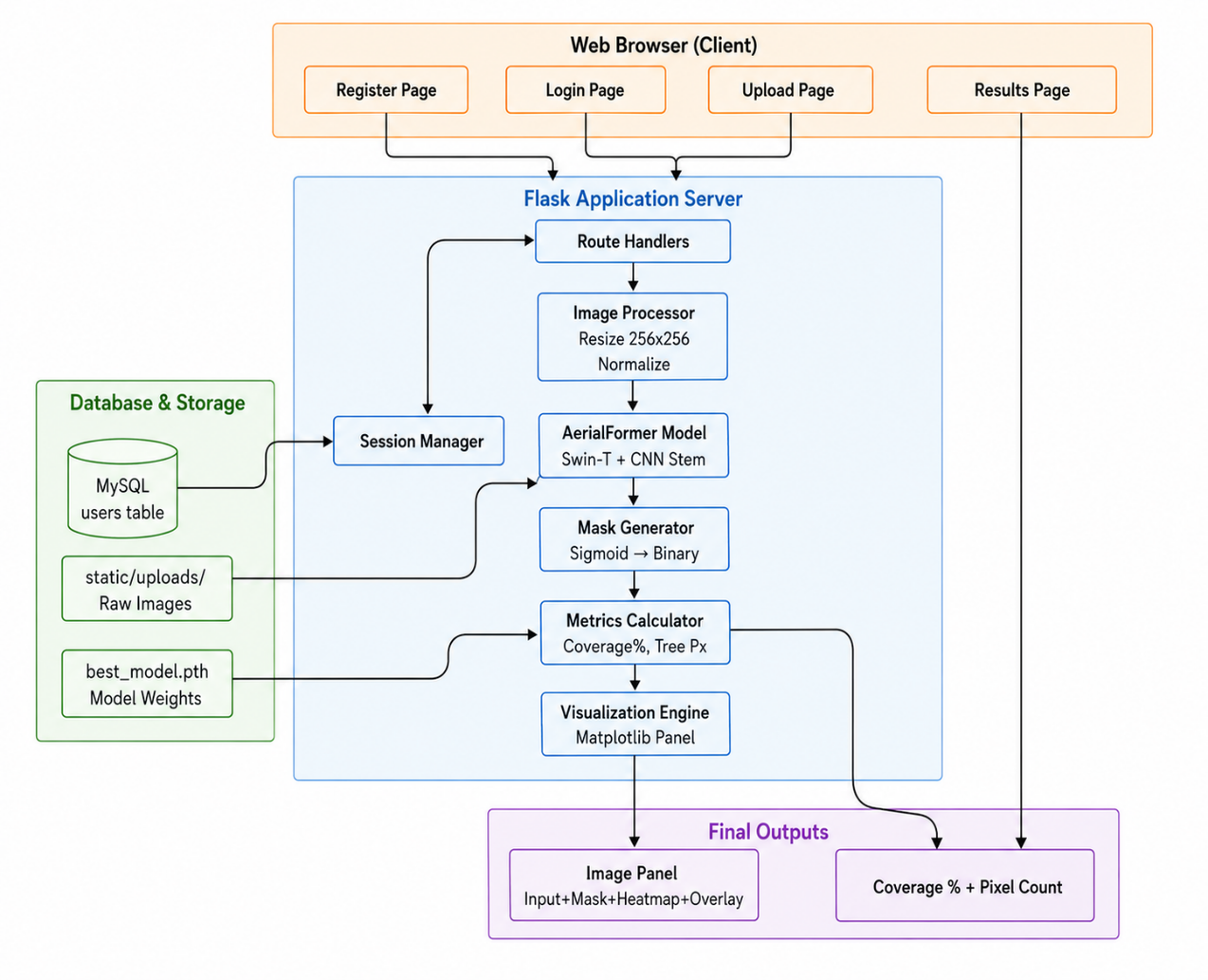
Block Diagram
Specifications
1. SOFTWARE REQUIREMENS
Operating System : Windows 7/8/10
Server-side Script : HTML, CSS, Bootstrap & JS
Programming Language : Python
Libraries : Flask, Pandas, Sklearn,Tim , NumPy, Seaborn, Matplotlib,pillow, Torch
IDE/Workbench : VSCode
Technology : Python 3.8+
Server Deployment : Xampp Server
Database : MySQL
2. HARDWARE REQUIREMENTS
Processor - I5/Intel Processor
RAM - 8GB+ (min)
Hard Disk - 128 GB+
Key Board - Standard Windows Keyboard
Mouse - Two or Three Button Mouse
Monitor - Any


 Paper Publishing

Request Call Back
Would you like to receive a free callback now?
Choose the best time for callback:
Leave your message and we will contact you as soon as possible

6-2-85/B, Old Maternity Hospital Road, Thyagaraja Nagar, Tirupati, Andhra Pradesh – 517501
+91 9030333433
+91 9393939065
0877-2261612

Disclaimer - Takeoff Edu Group Projects are not associated or affiliated with IEEE in any way. The IEEE Projects mentioned here are mentioned in the context of student projects, whose ideas are derived from IEEE publications, not projects of or by IEEE.

