Integration of Deep Learning Architectures With GRU for Automated Leukemia Detection in Peripheral Blood Smear Images
Objective
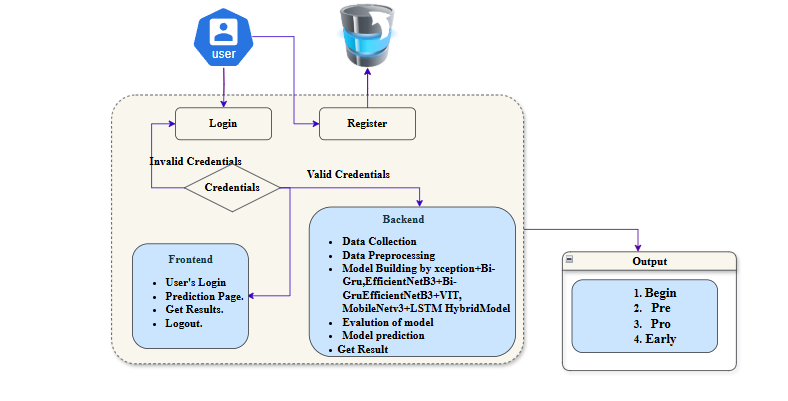
This project presents a web-based system for automated leukemia detection and classification from peripheral blood smear images using deep learning. It identifies four stages—Benign, Early, Pre-leukemic, and Pro-leukemic—using models like Xception-BiGRU, EfficientNetB3-BiGRU, EfficientNetB3-ViT, and MobileNetV3-LSTM. These models combine spatial and sequential feature extraction for high diagnostic accuracy. A Flask-based backend handles image processing and prediction, while the HTML frontend enables secure login, image upload, and result display. Trained on a Kaggle dataset, the system provides fast, reliable leukemia classification and aims to assist early diagnosis, reducing dependence on time-consuming manual analysis in clinical environments.
Abstract
This project introduces an advanced web-based system for automated leukemia detection and classification from peripheral blood smear images using deep learning techniques. The system focuses on identifying four distinct classes—Benign, Early, Pre-leukemic, and Pro-leukemic—using high-performance neural network architectures. A curated dataset from Kaggle serves as the foundation for training and validating the models. The implemented models include Xception combined with Bi-GRU, EfficientNetB3 fused with Bi-GRU, EfficientNetB3 with Vision Transformer (ViT), and MobileNetV3 paired with LSTM. These architectures enable robust spatial and sequential feature extraction, enhancing diagnostic accuracy. The backend is developed using Python and Flask, responsible for training, prediction, and secure user management. The frontend, designed with HTML, offers a seamless user experience, allowing individuals to register, log in, and upload blood smear images. Once an image is submitted, the system processes it through the trained models to deliver an accurate leukemia stage classification. This project bridges deep learning with healthcare, providing an accessible, fast, and intelligent tool for preliminary leukemia screening. It aims to assist medical practitioners in early diagnosis and reduce reliance on manual microscopic analysis, which is often subjective and time-consuming.
Keywords:
Leukemia detection, Blood smear classification, Deep learning, Xception,
EfficientNetB3, Bi-GRU, ViT, MobileNetV3, LSTM, Flask, Medical imaging, Web
application, Early diagnosis, AI in healthcare.
NOTE: Without the concern of our team, please don't submit to the college. This Abstract varies based on student requirements.
Block Diagram
Specifications
SOFTWARE REQUIREMENS
Operating System : Windows 7/8/10
Server-side Script : HTML, CSS, Bootstrap & JS
Programming Language : Python
Libraries : Flask, Pandas,Pytorch, Sklearn,NumPy, Seaborn, Matplotlib, Timm
IDE/Workbench : VSCode
Technology : Python 3.8+
Server Deployment : Xampp Server
Database : MySQL
HARDWARE REQUIREMENTS
Processor - I3/Intel Processor
RAM - 8GB (min)
Hard Disk - 128 GB
Key Board - Standard Windows Keyboard
Mouse - Two or Three Button Mouse
Monitor - Any


 Paper Publishing

Request Call Back
Would you like to receive a free callback now?
Choose the best time for callback:
Leave your message and we will contact you as soon as possible

6-2-85/B, Old Maternity Hospital Road, Thyagaraja Nagar, Tirupati, Andhra Pradesh – 517501
+91 9030333433
+91 9393939065
0877-2261612

Disclaimer - Takeoff Edu Group Projects are not associated or affiliated with IEEE in any way. The IEEE Projects mentioned here are mentioned in the context of student projects, whose ideas are derived from IEEE publications, not projects of or by IEEE.

