Integrating Transfer Learning and Flower Pollination Algorithm for Breast Cancer Histopathology Image Classification
Objective
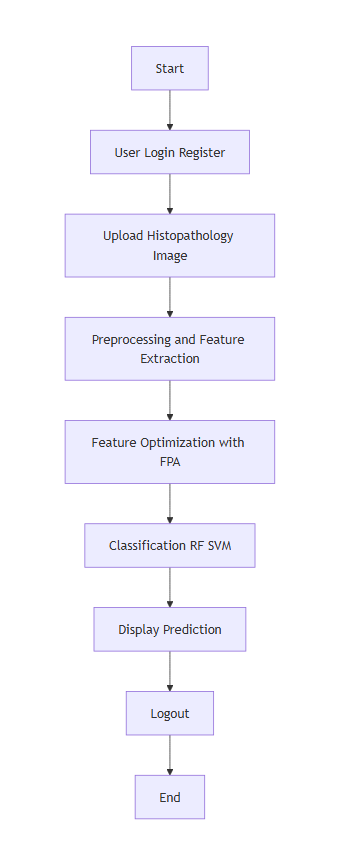
This project presents a hybrid approach for classifying breast cancer histopathology images by combining transfer learning and the Flower Pollination Algorithm (FPA) for feature optimization. Pre-trained CNN models—MobileNet, DenseNet, and EfficientNet—are used to extract deep features, which are then refined using FPA to remove redundancy. Optimized features are classified using Random Forest and SVM classifiers. The system is deployed as a user-friendly Flask web application for easy image upload and for accurate prediction. This integrated framework enhances classification accuracy, reduces computational complexity, and supports early diagnosis in breast cancer analysis.
Abstract
Breast cancer classification through histopathology images plays an essential role in early diagnosis and treatment planning. Manual examination of tissue slides can lead to inconsistencies due to complexity and visual similarity between classes. This project introduces a hybrid approach combining deep learning and nature-inspired optimization to improve classification accuracy. Three pre-trained convolutional neural network models—MobileNet, DenseNet, and EfficientNet—are employed for feature extraction using transfer learning. To refine these features, the Flower Pollination Algorithm (FPA) is used as an optimization strategy to reduce redundancy and highlight informative patterns. For the classification task, Random Forest and Support Vector Machine (SVM) models are applied based on the extracted and optimized features. A web interface built with Flask allows users to upload images, process data, and view classification results. This system aims to enhance diagnostic precision by integrating feature-rich representations and effective feature selection. Performance is evaluated based on accuracy, precision, recall, and F1-score. The combination of deep models and FPA contributes to a robust and efficient classification framework suitable for histopathology image analysis.
Keywords: Breast cancer, Histopathology, Transfer learning, MobileNet, DenseNet, EfficientNet, Flower Pollination Algorithm, Random Forest, SVM, Flask.
NOTE: Without the concern of our team, please don't submit to the college. This Abstract varies based on student requirements.
Block Diagram
Specifications
H/W CONFIGURATION:
Processor - I3/Intel Processor
Hard Disk - 160GB
Key Board - Standard Windows Keyboard
Mouse - Two or Three Button Mouse
Monitor - SVGA
RAM - 8GB
S/W CONFIGURATION:
• Operating System : Windows 7/8/10
• Server side Script : HTML, CSS, Bootstrap & JS
• Programming Language : Python
• Libraries : Flask, Pandas, MySQL. Connector, Scikit-Learn, pytorch
• IDE/Workbench : VS Code
• Technology : Python 3.8+
• Server Deployment : Xampp Server

Demo Video


Request for Video
 Paper Publishing
Request Call Back
Would you like to receive a free callback now?
Choose the best time for callback:
Leave your message and we will contact you as soon as possible

6-2-85/B, Old Maternity Hospital Road, Thyagaraja Nagar, Tirupati, Andhra Pradesh – 517501
+91 9030333433
+91 9393939065
0877-2261612

Disclaimer - Takeoff Edu Group Projects are not associated or affiliated with IEEE in any way. The IEEE Projects mentioned here are mentioned in the context of student projects, whose ideas are derived from IEEE publications, not projects of or by IEEE.

