Integrating AI for Enhanced Driver Safety: A Survey on Vehicle and Health Monitoring Systems
Objective
The objective is to evaluate the integration of AI-driven systems for enhancing driver safety through real-time vehicle and health monitoring. This involves analyzing how technologies such as sensors and cameras can detect and mitigate risks from driver impairment and health issues.
Abstract
In recent years, the intersection of vehicle safety and health monitoring has gained significant attention due to its potential to reduce road accidents caused by driver impairment. This project explores an innovative approach to enhancing driver safety through an integrated AI-driven system that combines vehicle monitoring with health assessment. Utilizing a Raspberry Pi as the central processing unit, this system incorporates several key components: a DC motor to simulate vehicle control, a web camera for real-time monitoring of driver alertness, a DHT11 sensor for environmental conditions, and a pulse sensor to track the driver’s physiological state.The web camera continuously analyzes the driver’s facial expressions and eye movement to detect signs of drowsiness. If the system identifies that the driver is falling asleep, it triggers the DC motor to stop, activates a buzzer to alert the driver, and displays a warning message on an LCD screen. Concurrently, the DHT11 sensor measures the environmental conditions, while the pulse sensor monitors the driver’s heart rate for any anomalies.In the event of detecting abnormal health conditions—such as irregular pulse rates—the system promptly deactivates the DC motor, increases the buzzer's intensity, and provides a visual alert on the LCD screen. This multi-faceted approach ensures a comprehensive safety mechanism, combining driver behavior monitoring with real-time health assessment to significantly reduce the risk of accidents due to driver fatigue or health issues. The effectiveness of this integrated system demonstrates a promising advancement in vehicle safety technology, leveraging AI and sensor technology to safeguard drivers and enhance road safety.
NOTE: Without the concern of our team, please don't submit to the college. This Abstract varies based on student requirements.
Block Diagram
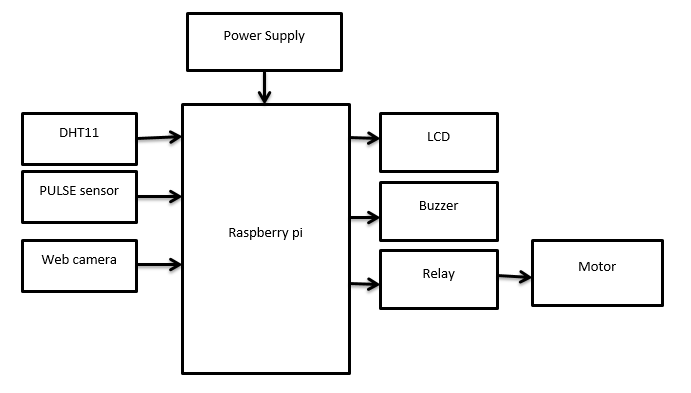
Specifications
Hardware Requirements:
- Raspberry pi
- DHT11
- Pulse sensor
- LCD
- RELAY
- DC Motor
- Powe supply
- Web Camera
- Buzzer
Software Requirements:
- Python IDLE
Learning Outcomes
- Raspberry pi diagram and Architecture
- Installation for Python IDLE
- Basic coding in Python
- Working of pulse sensor sensor
- How to connect DHT11 sensor to Raspberry oi?
- Working of DHT11
- Working of LCD
- Working of Relay ?
- How to connect LCD to Raspberry pi?
- Introduction to serial communication
- About Project Development Life Cycle:
- Planning and Requirement Gathering (software’s, Tools, Hardware components, etc.,)
- Schematic preparation
- Code development and debugging
- Hardware development and debugging
- Development of the Project and Output testing
- Practical exposure to:
- Hardware and software tools.
- Solution providing for real time problems.
- Working with team/ individual.
- Work on Creative ideas.
- Project development Skills
- Problem analyzing skills
- Problem solving skills
- Creativity and imaginary skills
- Programming skills
- Deployment
- Testing skills
- Debugging skills
- Project presentation skills
- Thesis writing skills


 Paper Publishing

Request Call Back
Would you like to receive a free callback now?
Choose the best time for callback:
Leave your message and we will contact you as soon as possible

6-2-85/B, Old Maternity Hospital Road, Thyagaraja Nagar, Tirupati, Andhra Pradesh – 517501
+91 9030333433
+91 9393939065
0877-2261612

Disclaimer - Takeoff Edu Group Projects are not associated or affiliated with IEEE in any way. The IEEE Projects mentioned here are mentioned in the context of student projects, whose ideas are derived from IEEE publications, not projects of or by IEEE.

