Innovations in Stroke Identification: A Machine Learning-Based Diagnostic Model Using Neuro images
Objective
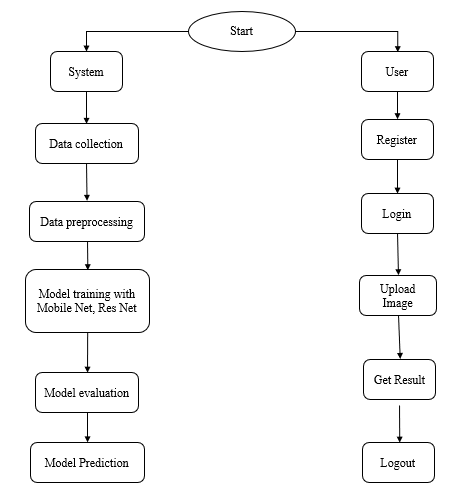
This project aims to develop a diagnostic model using ResNet and MobileNet architectures to classify neuroimages, enhancing stroke diagnosis accuracy and speed for early detection and timely intervention.
Abstract
The early and accurate diagnosis of stroke is critical for effective treatment and improved patient outcomes. Traditional diagnostic methods often face challenges in achieving high accuracy and efficiency. In this study, we propose an innovative machine learning-based diagnostic model utilizing ResNet and MobileNet architectures to classify neuroimages into normal and stroke categories. Our approach leverages the robust feature extraction capabilities of ResNet and the lightweight, efficient nature of MobileNet to create a comprehensive diagnostic tool. The model is trained on a diverse dataset of neuroimages, incorporating advanced preprocessing techniques to enhance its generalizability and performance. Initial experiments demonstrate that ResNet achieves a training accuracy of 94% with normal images, while MobileNet achieves an impressive 92% training accuracy with normal images. These results highlight the potential of our proposed model to significantly improve the accuracy and speed of stroke diagnosis, providing a valuable tool for clinicians and healthcare providers. Future work will focus on further validation with larger datasets and real-world clinical trials to establish the model's efficacy and reliability in clinical settings. This study underscores the transformative potential of deep learning models in advancing stroke diagnosis and enhancing patient care.
Keywords: Stroke Diagnosis, Machine Learning, Deep Learning, ResNet, MobileNet, Neuroimages, Medical Imaging, Stroke Classification, Diagnostic Model, Healthcare AI.
NOTE: Without the concern of our team, please don't submit to the college. This Abstract varies based on student requirements.
Block Diagram
Specifications
Hardware Requirements:
• Hard Disk - 160GB
• Key Board - Standard Windows Keyboard
• Mouse - Two or Three Button Mouse
• Monitor - SVGA
• RAM - 8GB
Software Requirements:
• Server side Script : HTML, CSS, Bootstrap & JS
• Programming Language : Python
• Libraries : Flask/Django, Pandas, Mysql.connector, Os, Smtplib, Numpy
• IDE/Workbench : PyCharm
• Technology : Python 3.6+
• Server Deployment : Xampp Server
• Database : MySQL

Demo Video


Request for Video
 Paper Publishing
Request Call Back
Would you like to receive a free callback now?
Choose the best time for callback:
Leave your message and we will contact you as soon as possible

6-2-85/B, Old Maternity Hospital Road, Thyagaraja Nagar, Tirupati, Andhra Pradesh – 517501
+91 9030333433
+91 9393939065
0877-2261612

Disclaimer - Takeoff Edu Group Projects are not associated or affiliated with IEEE in any way. The IEEE Projects mentioned here are mentioned in the context of student projects, whose ideas are derived from IEEE publications, not projects of or by IEEE.

