Improving Traffic Object Detection with Vehicle-Borne Fisheye Imaging
Objective
The primary objective of this project is to develop a robust and accurate traffic object detection framework for fisheye camera images by designing and implementing YOLO26-SPAC and YOLO11-CFA architectures that incorporate attention mechanisms capturing spatial, frequency, and multi-scale contextual features. The models are trained on the FE8K dataset to classify five traffic object categories: Bike, Bus, Car, Pedestrian, and Truck, with feature enhancements including spatial pyramid attention, cross-frequency attention, wavelet feature extraction, and global context embedding to improve detection accuracy and robustness against geometric distortions. The system’s performance is evaluated using metrics such as precision, recall, F1-score, and mAP, supported by visualization through confusion matrices, PR curves, and validation prediction grids. A modular framework integrating front-end and back-end components facilitates user interaction, image input, and prediction output. The framework is designed to handle variations in image resolution, object scale, and camera distortion efficiently, providing a scalable and reliable solution for accurate traffic object detection in fisheye imagery.
Abstract
ABSTRACT:
This project presents an advanced
traffic object detection system designed for vehicle-mounted fisheye cameras.
Traditional detection methods struggle with distortions and varying object
scales introduced by fisheye imaging. To overcome these challenges, two novel
deep learning architectures are employed: YOLO26-SPAC (Spatial Pyramid
Attention and Context) and YOLO11-CFA (Cross-Frequency Attention). YOLO26-SPAC
incorporates spatial pyramid attention and global context embedding, enabling
multi-scale feature extraction and enhancing localization of traffic objects.
YOLO11-CFA leverages cross-frequency attention and wavelet-based feature
extraction to capture both low- and high-frequency components, improving
robustness against geometric distortions. The system classifies traffic
entities into five categories: Bike, Bus, Car, Pedestrian, and Truck. Data
augmentation techniques such as mosaic, flipping, and scaling are applied to
improve model generalization. The framework is developed with a front-end using
HTML, CSS, and JavaScript, and a back-end using Python with the Flask
framework. Evaluation metrics include precision, recall, F1-score, mAP@0.5, and
mAP@0.5:0.95, with confusion matrices and validation predictions used to assess
model performance. This approach demonstrates improved detection accuracy,
better handling of distortions, and effective classification across multiple
traffic object types.
Keywords: Traffic detection, Fisheye imaging, YOLO26-SPAC, YOLO11-CFA,
Spatial Pyramid Attention, Cross-Frequency Attention, Wavelet features, Object
classification, Deep learning, Feature fusion
NOTE: Without the concern of our team, please don't submit to the college. This Abstract varies based on student requirements.
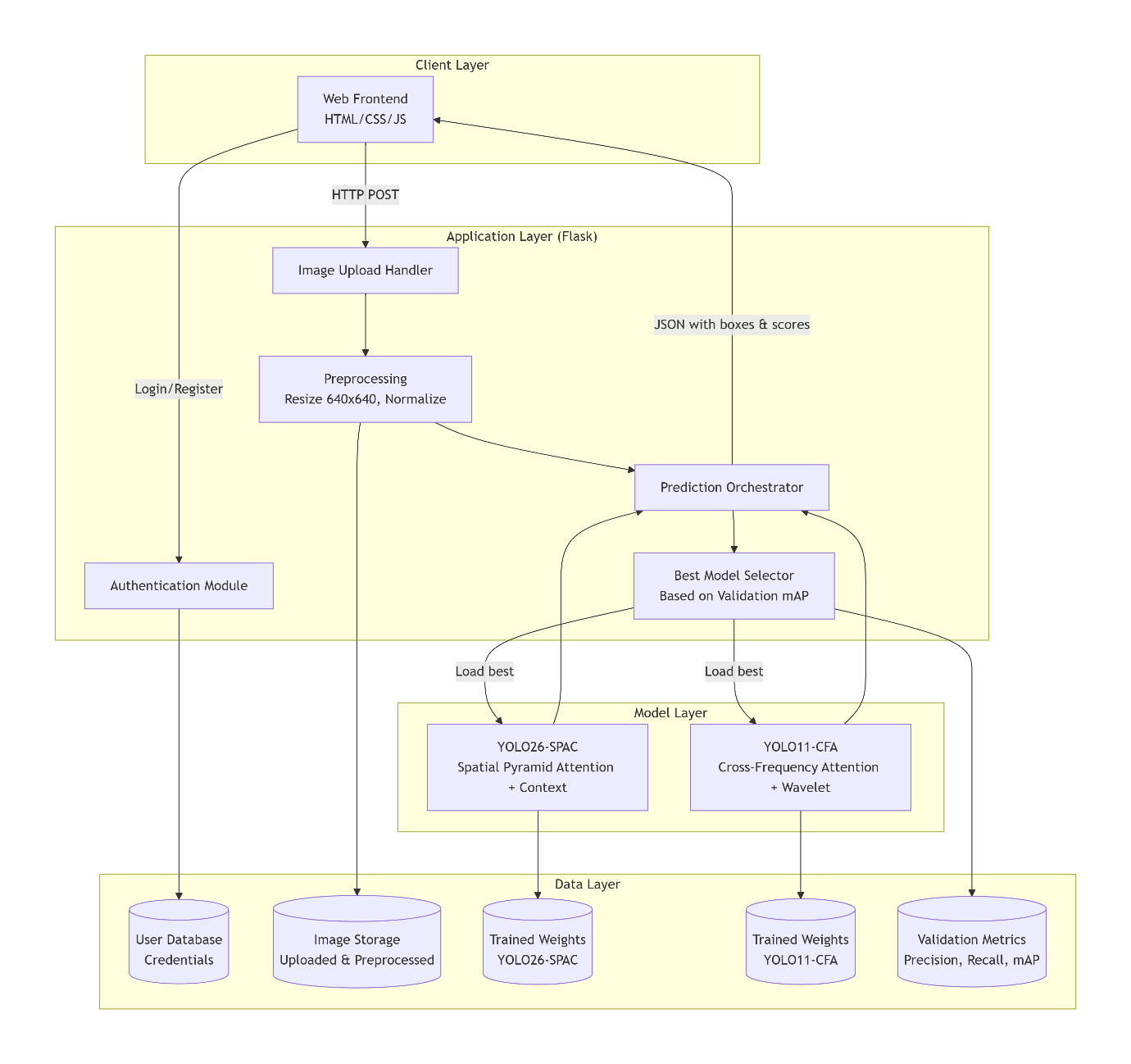
Block Diagram
Specifications
5.2 Hardware Requirements
• Processor - I5/Intel Processor
• RAM - 8GB (min)
• Hard Disk - 160 GB
• Key Board - Standard Windows Keyboard
• Mouse - Two or Three Button Mouse
• Monitor - Any
5.3 Software Requirements
• Operating System : Windows 7/8/10
• Server side Script : HTML, CSS, Bootstrap & JS
• Programming Language : Python
• Libraries : Flask, Pandas, Numpy, Mysql.connector, Os,
• IDE/Workbench : VS-Code
• Technology : Python 3.10+
• Server Deployment : Xampp Server
• Database : MySQL

Demo Video


Request for Video
 Paper Publishing
Request Call Back
Would you like to receive a free callback now?
Choose the best time for callback:
Leave your message and we will contact you as soon as possible

6-2-85/B, Old Maternity Hospital Road, Thyagaraja Nagar, Tirupati, Andhra Pradesh – 517501
+91 9030333433
+91 9393939065
0877-2261612

Disclaimer - Takeoff Edu Group Projects are not associated or affiliated with IEEE in any way. The IEEE Projects mentioned here are mentioned in the context of student projects, whose ideas are derived from IEEE publications, not projects of or by IEEE.

