Improving power consumption in IoT devices through neural network-based decision making
Objective
This study aims to develop an intelligent neural network–based framework for adaptive power and resource management in IoT-enabled fog computing, improving energy efficiency, workload balancing, and system scalability under dynamic conditions.
Abstract
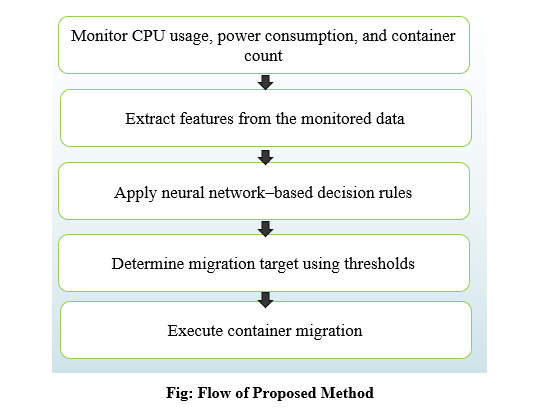
Efficient power management is a critical challenge in IoT-based fog computing environments due to limited energy resources, dynamic workloads, and heterogeneous devices. The existing method addresses this challenge by introducing a neural network–based decision-making framework for adaptive resource and power management. The system continuously monitors key operational parameters, including CPU utilization, power consumption, and the number of active containers on each fog node, to capture the real-time load and energy status of the infrastructure. These monitored metrics undergo a feature extraction process to generate meaningful representations of system states. The extracted features are used to train a Multilayer Perceptron (MLP) model, which learns the complex relationship between resource usage patterns and optimal migration decisions. Based on the learned behaviour, the neural network dynamically determines whether container migration is necessary and selects an appropriate destination, such as another fog node or the cloud, to balance workloads. This intelligent migration strategy aims to reduce excessive power consumption, prevent node overloading, and extend the battery lifetime of IoT devices. Compared to traditional static and rule-based approaches, the learning-driven framework offers improved adaptability to fluctuating workloads and changing network conditions. Overall, the method enhances energy efficiency and resource utilization in fog computing environments, making it suitable for scalable and sustainable IoT applications.
Keywords: Internet of Things; Energy Efficiency; Pareto Optimization; Neural Network Decision Making; Fog–Cloud Computing.
NOTE: Without the concern of our team, please don't submit to the college. This Abstract varies based on student requirements.
Block Diagram
Specifications
Software: Matlab 2022b or above
Hardware:
Operating Systems:
- Windows 10
- Windows 7 Service Pack 1
- Windows Server 2019
- Windows Server 2016
Processors:
Minimum: Any Intel or AMD x86-64 processor
Recommended: Any Intel or AMD x86-64 processor with four logical cores and AVX2 instruction set support
Disk:
Minimum: 2.9 GB of HDD space for MATLAB only, 5-8 GB for a typical installation
Recommended: An SSD is recommended A full installation of all MathWorks products may take up to 29 GB of disk space
RAM:
Minimum: 4 GB
Recommended: 8 GB
Learning Outcomes
· Introduction to Matlab
· What is EISPACK & LINPACK
· How to start with MATLAB
· About Matlab language
· Matlab coding skills
· About tools & libraries
· Application Program Interface in Matlab
· About Matlab desktop
· How to use Matlab editor to create M-Files
· Features of Matlab
· Basics on Matlab
· What is Signal Processing?
· About Signal Processing
· Introduction to Signal Processing
· How analog and digital signal is formed
· Importing the signal via signal acquisition tools
· Analyzing and manipulation of signals.
· Phases of signal processing:
· Acquisition
· Signal enhancement
· Signal restoration
· Medical Signal Processing
· Medical Signal Analysis
· Medical Signal Diagnosis
· Filtering techniques
· Machine Learning Algorithms
· Deep Learning Algorithms etc.
· How to extend our work to another real time applications
· Project development Skills
o Problem analyzing skills
o Problem solving skills
o Creativity and imaginary skills
o Programming skills
o Deployment
o Testing skills
o Debugging skills
o Project presentation skills
o Thesis writing skills
Demo Video


Request for Video
 Paper Publishing
Request Call Back
Would you like to receive a free callback now?
Choose the best time for callback:
Leave your message and we will contact you as soon as possible

6-2-85/B, Old Maternity Hospital Road, Thyagaraja Nagar, Tirupati, Andhra Pradesh – 517501
+91 9030333433
+91 9393939065
0877-2261612

Disclaimer - Takeoff Edu Group Projects are not associated or affiliated with IEEE in any way. The IEEE Projects mentioned here are mentioned in the context of student projects, whose ideas are derived from IEEE publications, not projects of or by IEEE.

