Improving Generalization of ML-Based IDS With Lifecycle-Based Dataset, Auto-LearningFeatures, and Deep Learning
Objective
The objective of this research is to develop an improved machine learning-based intrusion detection system (IDS) that enhances generalization and adaptability to evolving cyber threats. By leveraging lifecycle-based datasets, automatic feature learning, and deep learning models, the system aims to detect novel intrusions more effectively
Abstract
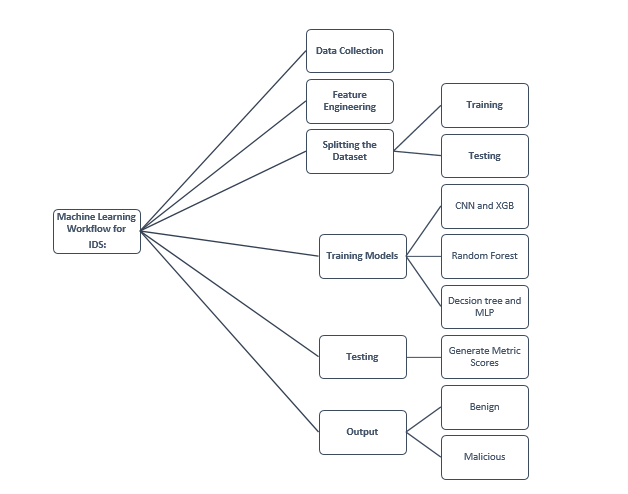
The increasing complexity and volume of network attacks necessitate robust intrusion detection systems (IDS). Current machine learning (ML)-based IDS often suffer from limited generalization capabilities when faced with dynamic attack behaviors. This research proposes an enhanced ML-based IDS framework utilizing lifecycle-based datasets, auto-learning features, and deep learning techniques to improve the detection of novel intrusions. The existing system leverages convolutional neural networks (CNN), but we explore alternatives such as decision trees, random forests, multilayer perceptrons (MLP), and XGBoost to enhance performance. By incorporating lifecycle datasets and automatic feature learning, this approach aims to improve the adaptability, accuracy, and scalability of IDS. Empirical evaluations reveal that the proposed system significantly enhances generalization and detection rates, providing a more resilient defense against sophisticated cyber threats.
Keywords: Intrusion Detection System (IDS), Lifecycle-Based Datasets, Decision Tree, Random Forest, XGBoost, MLP.
NOTE: Without the concern of our team, please don't submit to the college. This Abstract varies based on student requirements.
Block Diagram
Specifications
Hardware Requirements
· Operating system : Windows 7 or 7+
· RAM : 8 GB
· Hard disc or SSD : More than 500 GB
· Processor : Intel 3rd generation or high or Ryzen with 8 GB Ram
Software Requirements:
· Software’s : Python 3.6 or high version
· IDE : PyCharm/VSCode
· Framework : Flask, pandas, numpy and Scikit-Learn

Demo Video


Request for Video
 Paper Publishing
Request Call Back
Would you like to receive a free callback now?
Choose the best time for callback:
Leave your message and we will contact you as soon as possible

6-2-85/B, Old Maternity Hospital Road, Thyagaraja Nagar, Tirupati, Andhra Pradesh – 517501
+91 9030333433
+91 9393939065
0877-2261612

Disclaimer - Takeoff Edu Group Projects are not associated or affiliated with IEEE in any way. The IEEE Projects mentioned here are mentioned in the context of student projects, whose ideas are derived from IEEE publications, not projects of or by IEEE.

