Improved Power Quality in a Solar PV Plant Integrated Utility Grid by Employing a Novel Adaptive Current Regulator
Also Available Domains Solar Power Generation
Objective
The main objective of the proposed method is, to improve voltages and power quality under dynamic load changes.
Abstract
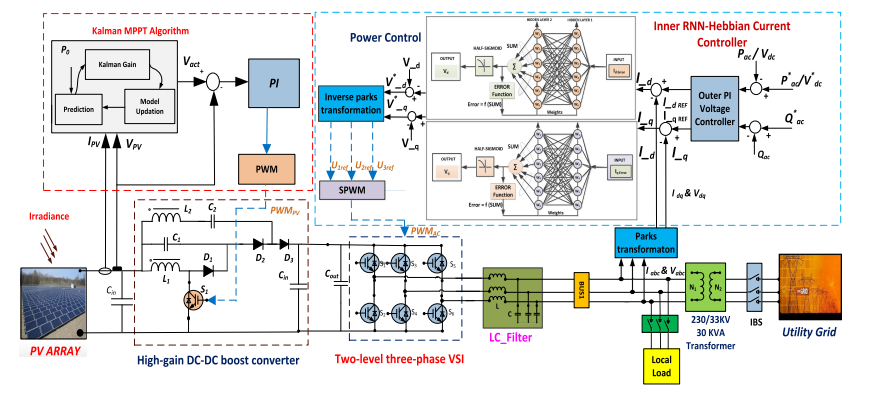
Integration of solar photovoltaic plants into the distribution systems using various power processing units produces the harmonics that may cause malfunctioning of sensitive equipment connected to the point of common coupling. To overcome this draw-back, a novel adaptive current regulator is employed for the grid interfacing voltage source inverter. In addition, a high-gain dc–dc converter with a Kalman-based maximum power point tracking algorithm is designed to achieve the high voltage level at the common dc bus. To determine three-phase reference currents, the proposed adaptive current regulator is designed by using a recurrent neural network trained with the Hebbian least mean square weight updating algorithm. They are used to generate the three-phase compensating currents for suppressing the harmonics present in the system. The proposed method has several merits, such as better harmonic mitigation ability, adaptive behavior, improved stability, and lesser settling time, as compared with the conventional PI controller. The system performance with the proposed current control regulator is analyzed via MATLAB/Simulink. Comparative analysis via simulation platform assures the improved performance in terms of power quality, settling time, and stability of the proposed controller.
Index Terms—Hebbian least mean square (LMS), high-gain converter, Kalman-based maximum power point tracking (MPPT), power quality, proportional–integral, photovoltaic (PV) system, recurrent neural network (RNN).
NOTE: Without the concern of our team, please don't submit to the college. This Abstract varies based on student requirements.
Block Diagram
Specifications
Software Configuration:
Operating System : Windows 7/8/10
Application Software : Matlab/Simulink
Hardware Configuration:
RAM : 8 GB
Processor : I3 / I5(Mostly prefer)
Learning Outcomes
- Introduction to Matlab/Simulink
- What is EISPACK & LINPACK
- How to start with MATLAB
- About Matlab language
- About tools & libraries
- Application of Matlab/Simulink
- About Matlab desktop
- Features of Matlab/Simulink
- Basics on Matlab/Simulink
- Introduction to controllers.
- Study of PWM techniques.
- Project Development Skills:
- Problem analyzing skills
- Problem solving skills
- Creativity and imaginary skills
- Programming skills
- Deployment
- Testing skills
- Debugging skills
- Project presentation skills
- Thesis writing skills
Demo Video


Request for Video
 Paper Publishing
Request Call Back
Would you like to receive a free callback now?
Choose the best time for callback:
Leave your message and we will contact you as soon as possible

6-2-85/B, Old Maternity Hospital Road, Thyagaraja Nagar, Tirupati, Andhra Pradesh – 517501
+91 9030333433
+91 9393939065
0877-2261612

Disclaimer - Takeoff Edu Group Projects are not associated or affiliated with IEEE in any way. The IEEE Projects mentioned here are mentioned in the context of student projects, whose ideas are derived from IEEE publications, not projects of or by IEEE.

