Implementation of Secure Smart Cart for Automatic Detection of Objects Using Arduino and RFID
Objective
The main objective of this project is to implement a Secure Smart Cart for automatic detection of objects using Arduino and RFID technology, enhancing the efficiency and security of the shopping experience.
Abstract
Shopping is easy but waiting on a bill counter after shopping is too boring and tedious task. Huge amount of rush plus cashier preparing the bill with barcode scanner is too time consuming and results in long ques. So here we have made an innovative project which will be placed in the shopping trolley itself.
The system consist of a RFID reader which is controlled by Arduino. So whenever the shopper puts any product in trolley it is been detected by the RFID module and it is displayed on LCD along with the price of the product. As the shopper adds more things it is detected by the module and the price according to that increases. At the end of shopping the shopper will press the button which when pressed adds all the product along with there price and gives the total bill to be paid.
Keywords: Arduino, RFID Reader, NodeMCU, LCD
NOTE: Without the concern of our team, please don't submit to the college. This Abstract varies based on student requirements.
Block Diagram
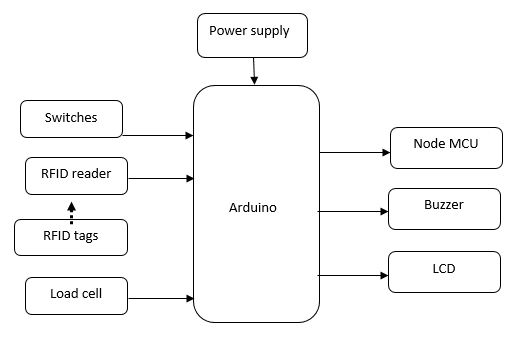
Specifications
Hardware requirements:
- Arduino
- RFID Module
- LCD
- Load cell
- NodeMCU
- Switch
- Power supply
Software requirements:
- Arduino IDE
- Embedded C
- Third party server
Learning Outcomes
- Arduino Pin diagram and Architecture
- How to install Arduino IDE Software
- Setting up and Installation procedures for Arduino IDE
- Introduction to Arduino IDE
- Commands in Embedded C
- How to install Libraries?
- Basic coding in Embedded C
- Working of RFID Reader
- How to interface RFID Reader with Arduino?
- Working of Swtch
- How to interface Switch with Arduino?
- Working of LCD
- How to interface LCD with Arduino?
- Working of NodeMCU
- How to interface NodeMCU with Arduino?
- About Project Development Life Cycle:
- Planning and Requirement Gathering (software’s, Tools, Hardware components, etc.,)
- Schematic preparation
- Code development and debugging
- Hardware development and debugging
- Development of the Project and Output testing
- Practical exposure to:
- Hardware and software tools.
- Solution providing for real time problems.
- Working with team/ individual.
- Work on Creative ideas.
- Project development Skills
- Problem analyzing skills
- Problem solving skills
- Creativity and imaginary skills
- Programming skills
- Deployment
- Testing skills
- Debugging skills
- Project presentation skills
- Thesis writing skills


 Paper Publishing

Request Call Back
Would you like to receive a free callback now?
Choose the best time for callback:
Leave your message and we will contact you as soon as possible

6-2-85/B, Old Maternity Hospital Road, Thyagaraja Nagar, Tirupati, Andhra Pradesh – 517501
+91 9030333433
+91 9393939065
0877-2261612

Disclaimer - Takeoff Edu Group Projects are not associated or affiliated with IEEE in any way. The IEEE Projects mentioned here are mentioned in the context of student projects, whose ideas are derived from IEEE publications, not projects of or by IEEE.

