Implementation of Lightweight Shuffle net Based CNN for Classification of Arrhythmia for Wearables.
Objective
To develop a lightweight Shuffle Net-based CNN for accurate, efficient ECG classification on resource-constrained wearable edge devices using focal loss.
Abstract
Recent
developments in wearable technology and artificial intelligence (AI) have
improved the accuracy of identifying a variety of arrhythmias from recorded
electrocardiogram (ECG) signals. Deep Neural Networks (DNNs) require compute-
and memory-intensive operations to achieve high accuracy in ECG classification.
As a result, their implementation is limited to devices with powerful computing
capabilities, and they are not appropriate for wearable edge devices.
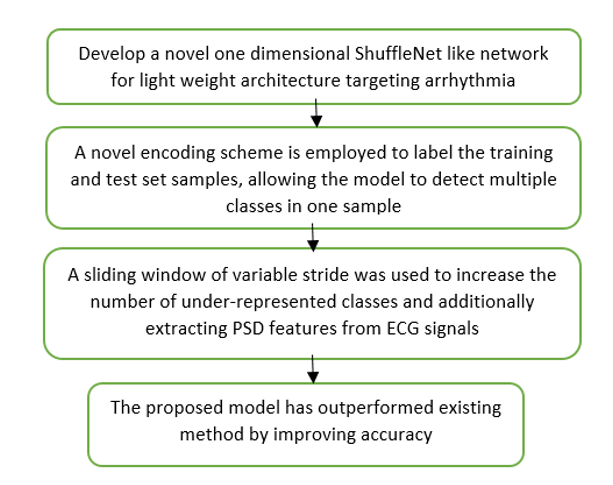
This research proposes and implements a lightweight Convolution Neural Network
(CNN) model based on the ShuffleNet architecture as a solution to ease the
deployment of deep neural networks on wearable mobile edge devices with
constrained resources. A variable stride sliding window is employed to augment
the quantity of underrepresented classes within the database. Additionally, the
model is able to identify many classes in a single ECG segment because to the
use of a new encoding strategy for labelling and training test set samples.
This paper also investigated a loss function called focal loss, which was found
to be useful for DNN training on an unbalanced dataset. With 9 times less
trainable parameters than the conventional CNN, the suggested model
outperformed it and increased the F1-score by 2%.
Keywords: ECG, AI, Health Care, ShuffleNet based CNN, Wearable Electronics.
NOTE: Without the concern of our team, please don't submit to the college. This Abstract varies based on student requirements.
Block Diagram
Specifications
Software: Matlab 2020a or above
Hardware:
Operating Systems:
- Windows 10
- Windows 7 Service Pack 1
- Windows Server 2019
- Windows Server 2016
Processors:
Minimum: Any Intel or AMD x86-64 processor
Recommended: Any Intel or AMD x86-64 processor with four logical cores and AVX2 instruction set support
Disk:
Minimum: 2.9 GB of HDD space for MATLAB only, 5-8 GB for a typical installation
Recommended: An SSD is recommended A full installation of all MathWorks products may take up to 29 GB of disk space
RAM:
Minimum: 4 GB
Recommended: 8 GB
Learning Outcomes
· Introduction to Matlab
· What is EISPACK & LINPACK
· How to start with MATLAB
· About Matlab language
· Matlab coding skills
· About tools & libraries
· Application Program Interface in Matlab
· About Matlab desktop
· How to use Matlab editor to create M-Files
· Features of Matlab
· Basics on Matlab
· What is Signal Processing?
· About Signal Processing
· Introduction to Signal Processing
· How analog and digital signal is formed
· Importing the signal via signal acquisition tools
· Analyzing and manipulation of signals.
· Phases of signal processing:
· Acquisition
· Signal enhancement
· Signal restoration
· Medical Signal Processing
· Medical Signal Analysis
· Medical Signal Diagnosis
· Filtering techniques
· Machine Learning Algorithms
· Deep Learning Algorithms etc.
· How to extend our work to another real time applications
· Project development Skills
o Problem analyzing skills
o Problem solving skills
o Creativity and imaginary skills
o Programming skills
o Deployment
o Testing skills
o Debugging skills
o Project presentation skills
o Thesis writing skills


 Paper Publishing

Request Call Back
Would you like to receive a free callback now?
Choose the best time for callback:
Leave your message and we will contact you as soon as possible

6-2-85/B, Old Maternity Hospital Road, Thyagaraja Nagar, Tirupati, Andhra Pradesh – 517501
+91 9030333433
+91 9393939065
0877-2261612

Disclaimer - Takeoff Edu Group Projects are not associated or affiliated with IEEE in any way. The IEEE Projects mentioned here are mentioned in the context of student projects, whose ideas are derived from IEEE publications, not projects of or by IEEE.

