Implementation of FIR Filter Using Different Adder Architectures
Objective
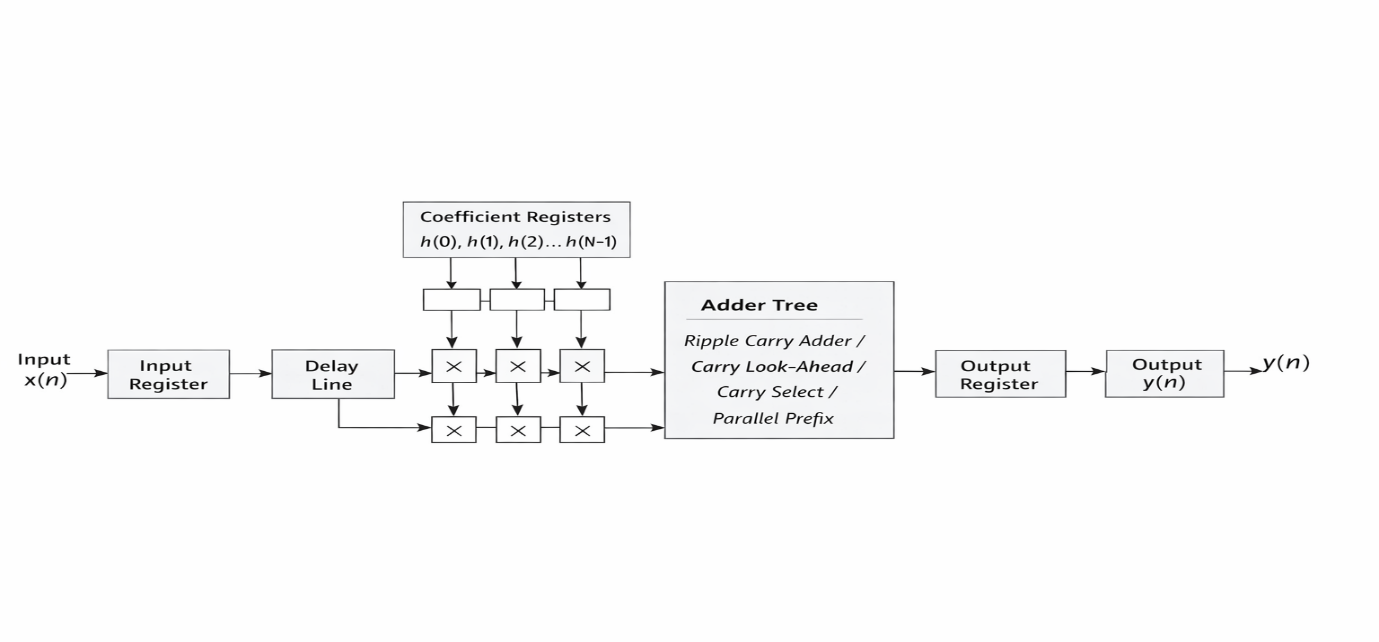
The objective of this project is to design and implement a Finite Impulse Response (FIR) filter using different adder architectures for efficient digital signal processing. It focuses on analyzing the impact of various adders on the filter’s speed, power consumption, and hardware complexity. Different adder structures such as Ripple Carry, Carry Look-Ahead, and Carry Save Adders will be implemented and compared. Simulation and verification will be carried out to evaluate the filter’s performance in terms of delay, area, and power. The overall goal is to develop an optimized FIR filter design suitable for high-speed and low-power signal processing applications.
Abstract
Abstract:
In this, concentrating on the real time demands of digital signal processing, a delay and power efficient form low pass FIR filter is realized using FPGA. The filter coefficients are generated using Kaiser Window function of MATLAB FDA tool. For obtaining the high speed operation at reasonable power, various adder architectures are considered for the filter design along with vedic multiplier. The designs were implemented on Artix-7 xc7a100tcsg324-1 FPGA board and debugged using Virtual Input/output IP of Xilinx Vivado to validate the results. Experimental results show that efficiency in power-delay product can be obtained by using Carry Increment Adder for FIR filter design than that of various other multi-bit adder structures.NOTE: Without the concern of our team, please don't submit to the college. This Abstract varies based on student requirements.
Block Diagram
Specifications
Software Requirements:
· Xilinx ISE14.7 Suite/Vivado2018.3 Tool.
· HDL: Verilog.
Hardware Requirements:
· Microsoft® Windows XP.
· Intel® Pentium® 4 processor or Pentium 4 equivalent with SSE support.
· 512 MB RAM.
· 100 MB of available disk space.
Learning Outcomes
· Understand FIR filter fundamentals and MAC-based architectures
· Analyze the impact of different adder architectures on performance
· Design FIR filters using Verilog HDL
· Evaluate digital circuits based on delay, power, and area
· Compare hardware architectures for real-time signal processing
· Develop optimized and scalable DSP hardware designs


Related Projects
 Paper Publishing

Request Call Back
Would you like to receive a free callback now?
Choose the best time for callback:
Leave your message and we will contact you as soon as possible

6-2-85/B, Old Maternity Hospital Road, Thyagaraja Nagar, Tirupati, Andhra Pradesh – 517501
+91 9030333433
+91 9393939065
0877-2261612

Disclaimer - Takeoff Edu Group Projects are not associated or affiliated with IEEE in any way. The IEEE Projects mentioned here are mentioned in the context of student projects, whose ideas are derived from IEEE publications, not projects of or by IEEE.

