Identifying Depression Through Deep Learning Techniques
Objective
To develop a real-time, AI-powered system using Raspberry Pi that detects early signs of depression by monitoring physiological signals (temperature and heart rate) and emotional indicators (facial expressions) through deep learning. The system aims to provide a non-invasive and accessible solution for continuous mental health monitoring.
Abstract
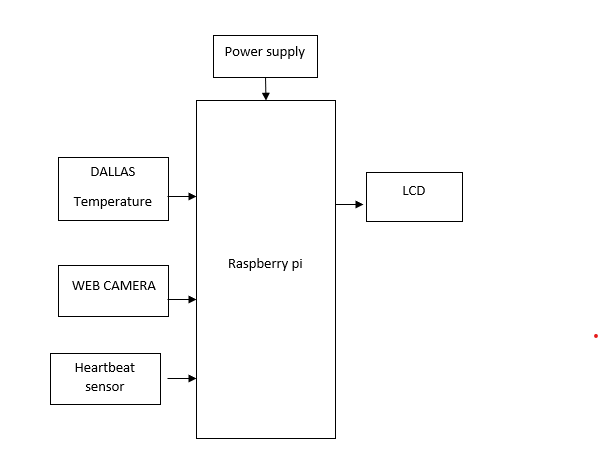
This project presents an AI-powered system for early-stage depression detection by integrating physiological and emotional indicators using deep learning techniques. The system is built on a Raspberry Pi microcontroller and incorporates a Dallas temperature sensor, a heartbeat sensor, and a web camera to monitor the user's physical and emotional states in real time. The temperature and heart rate sensors continuously track the user's vital signs, while the webcam captures facial expressions to analyze emotions using a deep learning model. An LCD display is included to show real-time readings of temperature, heart rate, and the detected emotion for user awareness. When the system detects elevated temperature and heart rate alongside a sad emotion, it classifies the condition as potential depression and issues a corresponding alert. If only a sad emotion is detected while physiological parameters remain normal, the system displays the emotional state without triggering a warning. This fusion of biometric sensing, AI-based emotion recognition, and real-time display offers a non-invasive, cost-effective, and accessible solution for mental health monitoring and early depression detection.
NOTE: Without the concern of our team, please don't submit to the college. This Abstract varies based on student requirements.
Block Diagram
Specifications
Hardware Requirements
- Raspberry pi
- Dallas temperature sensor
- Heart beat sensor
- Power supply
- LCD
- USB web camera
Software Requirements
- RASBERRY PI INTERFACE
Learning Outcomes
- - Understanding Arduino architecture and pin configuration
- - Installing and setting up Arduino IDE for development
- - Writing and uploading Arduino programs for biometric authentication
- - Interfacing fingerprint sensors with Arduino for secure access control
- - Controlling DC motors using a motor driver for door automation
- - Implementing push buttons for manual authentication control
- - Displaying authentication status on an LCD screen
- - Understanding power supply requirements for biometric systems
- About Project Development Life Cycle:
- Planning and Requirement Gathering (software’s, Tools, Hardware components, etc.,)
- Schematic preparation
- Code development and debugging
- Hardware development and debugging
- Development of the Project and Output testing
- Practical exposure to:
- Hardware and software tools.
- Solution providing for real time problems.
- Working with team/ individual.
- Work on Creative ideas.
- Project development Skills
- Problem analyzing skills
- Problem solving skills
- Creativity and imaginary skills
- Programming skills
- Deployment
- Testing skills
- Debugging skills
- Project presentation skills
- Thesis writing skills


 Paper Publishing

Request Call Back
Would you like to receive a free callback now?
Choose the best time for callback:
Leave your message and we will contact you as soon as possible

6-2-85/B, Old Maternity Hospital Road, Thyagaraja Nagar, Tirupati, Andhra Pradesh – 517501
+91 9030333433
+91 9393939065
0877-2261612

Disclaimer - Takeoff Edu Group Projects are not associated or affiliated with IEEE in any way. The IEEE Projects mentioned here are mentioned in the context of student projects, whose ideas are derived from IEEE publications, not projects of or by IEEE.

