Hybrid Wavelet-Swin Transformer and Dual-Path Attention Networks for Robust Skin Lesion Segmentation
Objective
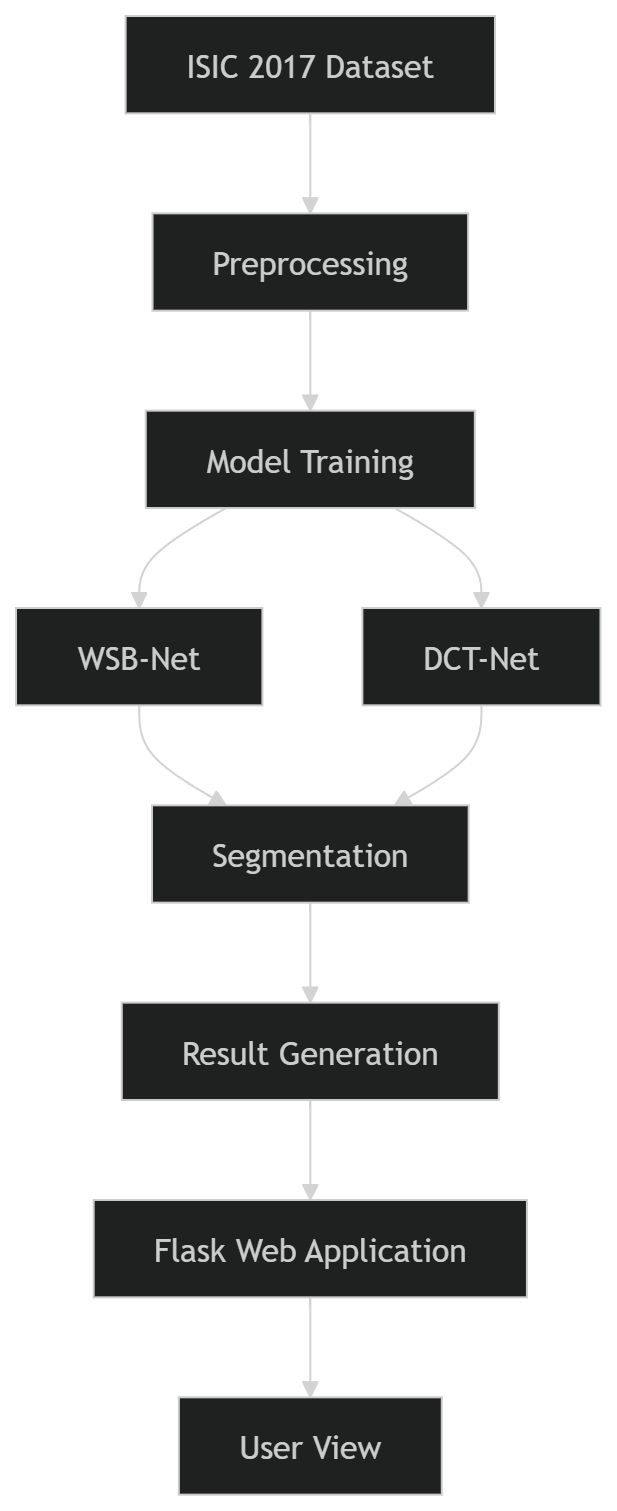
Hybrid Wavelet-Swin Transformer and Dual-Path Attention Networks for Robust Skin Lesion Segmentation project presents an advanced deep learning framework for accurate skin lesion segmentation using dermoscopic images from the ISIC 2017 dataset. The proposed system aims to improve lesion boundary detection and feature extraction by combining convolutional and transformer-based architectures. Two segmentation models are developed and evaluated: WSB-Net, which integrates Wavelet Transform, Swin Transformer, and Boundary Refinement modules to capture fine-grained texture details and precise lesion boundaries, and DCT-Net, which combines a Dual-Path CNN, Transformer encoder, and Cross-Attention mechanism to learn both local and global image representations. A Flask-based web application is implemented to provide an interactive platform where users can register, log in, upload skin lesion images, and obtain segmented outputs. By leveraging complementary feature learning strategies, the framework enhances segmentation accuracy, boundary precision, and overall model robustness. The project demonstrates the effectiveness of hybrid deep learning techniques for skin lesion analysis and provides a practical solution for automated lesion segmentation.
Abstract
Skin lesion
segmentation plays an important role in the analysis of dermoscopic images and
supports the identification of different skin abnormalities. Accurate
segmentation helps in isolating lesion regions from surrounding healthy skin,
which improves the quality of further analysis. This project presents a hybrid
deep learning framework titled "Hybrid
Wavelet-Swin Transformer and Dual-Path Attention Networks for Robust Skin
Lesion Segmentation." The proposed system
utilizes the ISIC 2017 skin lesion dataset for training and evaluation. Two
advanced segmentation models are implemented and compared. The first model, WSB-Net, combines Wavelet
Transform, Swin Transformer, and Boundary Refinement techniques to capture
detailed texture information and produce accurate lesion boundaries. The second
model, DCT-Net,
integrates a Dual-Path CNN, Transformer architecture, and Cross-Attention
mechanism to learn both local and global image features effectively. The system
is developed using Flask with an interactive web interface that includes
modules such as Home, Register, Login, Segmentation, and Logout. Users can
upload dermoscopic images and obtain segmented lesion outputs through the
application. The framework focuses on improving segmentation quality, boundary
precision, and feature representation while maintaining an efficient workflow.
Experimental evaluation demonstrates the effectiveness of combining
convolutional and transformer-based architectures for skin lesion segmentation
tasks. The developed system provides a reliable platform for analyzing skin
lesion images using modern deep learning approaches.
Keywords: Skin Lesion Segmentation, Deep Learning, Swin Transformer, Wavelet Transform, Cross-Attention, Convolutional Neural Network, Image Segmentation, Dermoscopic Images, Boundary Refinement, Flask Framework
NOTE: Without the concern of our team, please don't submit to the college. This Abstract varies based on student requirements.
Block Diagram
Specifications
5.2 Hardware Requirements
Processor - I3/Intel Processor
Hard Disk - 160GB
Key Board - Standard Windows Keyboard
Mouse - Two or Three Button Mouse
Monitor - SVGA
RAM - 8GB
5.3 Software Requirements
• Operating System : Windows 7/8/10
• Programming Language : Python
• Libraries : Pandas, Numpy, scikit-learn, pytorch
• IDE/Workbench : Visual Studio Code.

Demo Video


Request for Video
 Paper Publishing
Request Call Back
Would you like to receive a free callback now?
Choose the best time for callback:
Leave your message and we will contact you as soon as possible

6-2-85/B, Old Maternity Hospital Road, Thyagaraja Nagar, Tirupati, Andhra Pradesh – 517501
+91 9030333433
+91 9393939065
0877-2261612

Disclaimer - Takeoff Edu Group Projects are not associated or affiliated with IEEE in any way. The IEEE Projects mentioned here are mentioned in the context of student projects, whose ideas are derived from IEEE publications, not projects of or by IEEE.

