Hybrid Nave Bayes Models for Scam Detection Comparative Insights From Email and Financial Fraud
Objective
The objective of this project is to develop a hybrid machine learning-based system for accurately detecting fraudulent emails and financial transactions.
Abstract
The growing threat of email and financial fraud necessitates the development of efficient and scalable detection systems. This project presents a hybrid approach to fraud detection, leveraging multiple machine learning models such as XGBoost, Random Forest, LightGBM, and Naive Bayes to classify emails as fraudulent or legitimate. The project incorporates TF-IDF and BERT embeddings to extract features from the email text, enhancing the ability of the models to understand and differentiate between legitimate and phishing emails. The stacking classifier approach is employed to combine the strengths of these individual models, further improving detection accuracy. The system is evaluated using performance metrics such as accuracy, precision, recall, and F1-score. The results show that the hybrid model outperforms traditional approaches in terms of accuracy and reliability. This system provides a scalable and adaptable solution for detecting fraudulent emails, offering higher precision and lower error rates. The integration of deep learning techniques and ensemble methods positions this research as a significant contribution to the field of fraud detection.
Keywords: Hybrid Models, XGBoost, Naive Bayes, Random Forest, LightGBM, TF-IDF, BERT, Stacking Classifier, Email Fraud Detection, Financial Fraud.
NOTE: Without the concern of our team, please don't submit to the college. This Abstract varies based on student requirements.
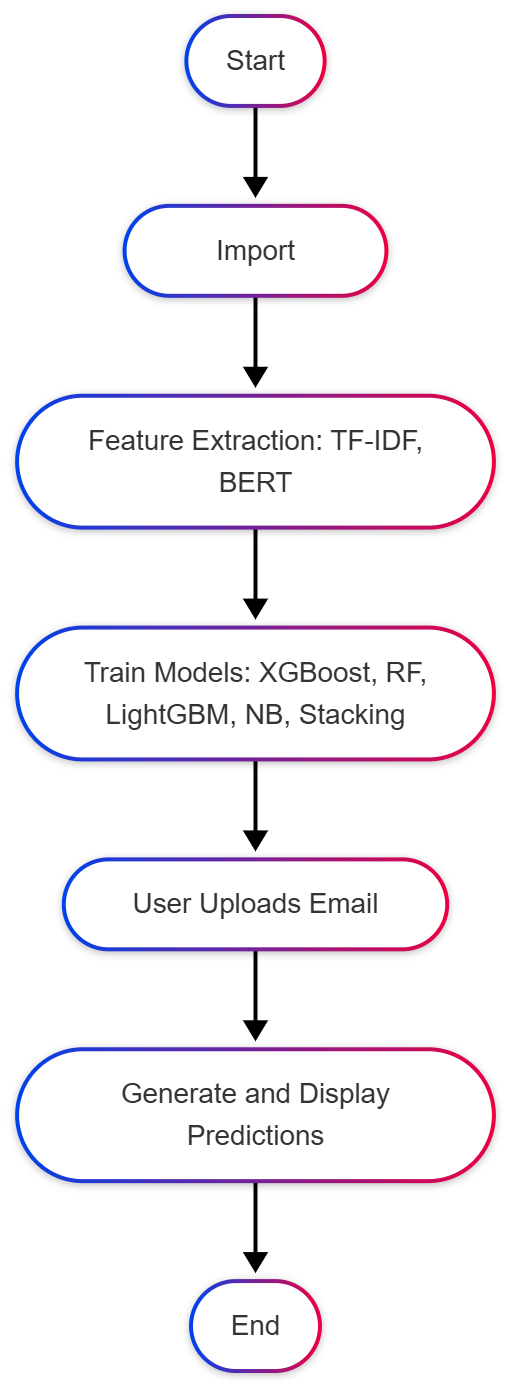
Block Diagram
Specifications
SOFTWARE REQUIREMENS
Operating System : Windows 7/8/10
Server side Script : HTML, CSS, Bootstrap & JS
Programming Language : Python
Libraries Flask, Pandas, Torch, Sklearn, Librosa, Numpy , Seaborn, Matplotlib
IDE/Workbench : VSCode
Server Deployment : Xampp Server
Database : MySQL
HARDWARE REQUIREMENTS
Processor - I3/Intel Processor
RAM - 8GB (min)
Hard Disk - 128 GB
Key Board - Standard Windows Keyboard
Mouse - Two or Three Button Mouse
Monitor - Any


 Paper Publishing

Request Call Back
Would you like to receive a free callback now?
Choose the best time for callback:
Leave your message and we will contact you as soon as possible

6-2-85/B, Old Maternity Hospital Road, Thyagaraja Nagar, Tirupati, Andhra Pradesh – 517501
+91 9030333433
+91 9393939065
0877-2261612

Disclaimer - Takeoff Edu Group Projects are not associated or affiliated with IEEE in any way. The IEEE Projects mentioned here are mentioned in the context of student projects, whose ideas are derived from IEEE publications, not projects of or by IEEE.

