Hybrid model for multi-class brain tumor classification
Objective
This project focuses on developing a hybrid deep learning model for accurate multi-class classification of brain tumors using MRI images. The model combines advanced architectures including EfficientNetB2, MobileNetV2, and DenseNet121 to effectively extract and fuse features from medical images. The Models used are, Multi-Branch CNN+EfficientB2, MobilenetV2+EfficientB2 and Densenet121+SE blocks with EfficientNetB2 .The model’s performance was evaluated using accuracy, precision, recall, and F1-score, along with confusion matrix analysis for detailed insights. To ensure practical usability, the trained model was deployed through a web application built with Flask, HTML, CSS, and JavaScript, allowing users to upload MRI scans and receive accuarate tumor classification results.
Abstract
This project focuses on designing and implementing a hybrid deep learning model for multi-class classification of brain tumor images. The classification process aims to distinguish between multiple types of brain tumors using advanced convolutional neural network (CNN) architectures. The hybrid model integrates multiple deep learning components, including Multi-Branch CNN, EfficientNetB2, MobileNetV2, DenseNet121, and SE (Squeeze-and-Excitation) Blocks. These models are strategically combined to extract deep hierarchical features, enhance model generalization, and improve classification accuracy. The input dataset consists of brain tumor images obtained from a structured image dataset available on a data-sharing platform. Preprocessing techniques are applied to normalize and resize the images for better training performance. Feature extraction and fusion are carried out through combined model architectures. The model is trained using supervised learning techniques and validated using evaluation metrics such as accuracy, precision, recall, and F1-score. The front-end of the system is built using HTML, CSS, and JavaScript, while the back-end is powered by Python and Flask. The system allows users to register, log in, classify tumor images, and log out. The classification module uses the hybrid model to predict the type of brain tumor from the input image. This approach leverages both the robustness of CNN architectures and the efficiency of modern neural networks to produce reliable classification outputs. The fusion of various models aims to reduce overfitting, handle image variations effectively, and ensure faster convergence. The modular implementation also ensures better scalability and maintainability. Overall, the proposed hybrid model provides a systematic approach for solving multi-class image classification tasks with improved efficiency and higher accuracy.
Keywords: Brain Tumor, Multi-Class Classification, Hybrid Model, CNN, EfficientNetB2, MobileNetV2, DenseNet121, SE Blocks, Deep Learning, Flask
NOTE: Without the concern of our team, please don't submit to the college. This Abstract varies based on student requirements.
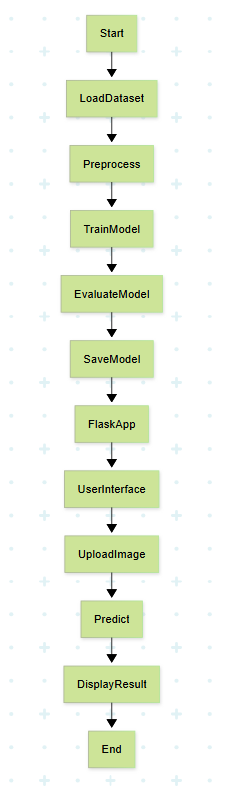
Block Diagram
Specifications
H/W CONFIGURATION:
Processor - I3/Intel Processor
Hard Disk - 160GB
Key Board - Standard Windows Keyboard
Mouse - Two or Three Button Mouse
Monitor - SVGA
RAM - 8GB
S/W CONFIGURATION:
• Operating System : Windows 7/8/10
• Server side Script : HTML, CSS, Bootstrap & JS
• Programming Language : Python
• Libraries : Flask, Pandas, MySQL. Connector, Scikit-Learn, pytorch
• IDE/Workbench : VS Code
• Technology : Python 3.8+
• Server Deployment : Xampp Server

Demo Video


Request for Video
 Paper Publishing
Request Call Back
Would you like to receive a free callback now?
Choose the best time for callback:
Leave your message and we will contact you as soon as possible

6-2-85/B, Old Maternity Hospital Road, Thyagaraja Nagar, Tirupati, Andhra Pradesh – 517501
+91 9030333433
+91 9393939065
0877-2261612

Disclaimer - Takeoff Edu Group Projects are not associated or affiliated with IEEE in any way. The IEEE Projects mentioned here are mentioned in the context of student projects, whose ideas are derived from IEEE publications, not projects of or by IEEE.

