Hybrid Method Combining Variational Mode Decomposition and Deep Neural Networks for Predicting PM2.5 Concentration in China
Objective
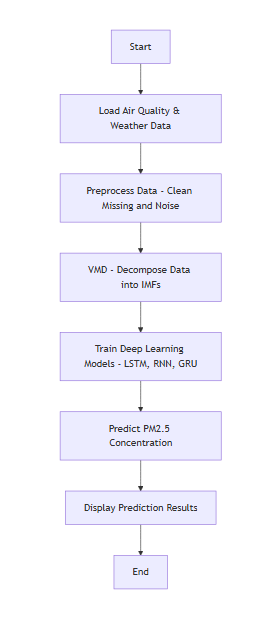
This project uses a hybrid method combining Variational Mode Decomposition (VMD) and deep learning models like LSTM and GRU to predict PM2.5 levels in China. It processes air quality and weather data to improve forecasting accuracy and understand pollution patterns.
Abstract
This project presents a hybrid approach combining Variational Mode Decomposition (VMD) and Deep learning model for predicting PM2.5 concentrations in China. The dataset consists of 4,136 records containing air quality and weather data, including PM2.5, PM10, NOx, CO, Ozone, temperature, humidity, wind speed, and solar radiation. Several missing values, particularly for certain volatile compounds like Xylene and Eth-Benzene, were identified and addressed during preprocessing. The hybrid model integrates VMD to decompose complex time series data and employs advanced DNN architectures, such as LSTM, RNN, GRU, and linear regression, for accurate forecasting. The primary objective is to develop a reliable model for PM2.5 concentration prediction, which can be pivotal for understanding air pollution dynamics. The study demonstrates the potential of combining signal processing techniques with deep learning models to enhance predictive accuracy in environmental datasets.
Keywords: Variational Mode Decomposition, Deep Neural Networks, PM2.5, LSTM, RNN, GRU, air quality prediction, machine learning, environmental monitoring, data preprocessing.
NOTE: Without the concern of our team, please don't submit to the college. This Abstract varies based on student requirements.
Block Diagram
Specifications
H/W CONFIGURATION:
Processor - I3/Intel Processor
Hard Disk - 160GB
Key Board - Standard Windows Keyboard
Mouse - Two or Three Button Mouse
Monitor - SVGA
RAM - 8GB
S/W CONFIGURATION:
• Operating System : Windows 7/8/10
• Server side Script : HTML, CSS, Bootstrap & JS
• Programming Language : Python
• Libraries : Flask, Pandas, MySQL. Connector, Scikit-Learn
• IDE/Workbench : VS Code
• Technology : Python 3.8+
• Server Deployment : Xampp Server


 Paper Publishing

Request Call Back
Would you like to receive a free callback now?
Choose the best time for callback:
Leave your message and we will contact you as soon as possible

6-2-85/B, Old Maternity Hospital Road, Thyagaraja Nagar, Tirupati, Andhra Pradesh – 517501
+91 9030333433
+91 9393939065
0877-2261612

Disclaimer - Takeoff Edu Group Projects are not associated or affiliated with IEEE in any way. The IEEE Projects mentioned here are mentioned in the context of student projects, whose ideas are derived from IEEE publications, not projects of or by IEEE.

